Three projects reaching students that formal education has left behind. Over 273 million children and young people are currently out of school, according to UNESCO’s most recent data. Millions more sit in overcrowded classrooms with too few resources and too little individualised support. The debate about AI in education has so far focused heavily on classrooms that do have resources: the risks of students bypassing genuine learning, the erosion of attention and curiosity, and the struggle educators face in adapting to a technology that outpaces policy. Those concerns are real and worth taking seriously. But they describe a specific problem in a specific context. In classrooms where formal education consistently falls short, the real struggle is a lack of support rather than an overabundance. This is where we’re seeing a new, less-talked-about side of AI in education start to emerge.

The world’s most underserved classrooms share a common problem that has nothing to do with motivation or ability: the digital tools designed to improve education almost universally assume an internet connection. For the roughly 2.6 billion people globally without reliable internet access, that assumption alone is enough to put most edtech solutions out of reach.
Kolibri, built by the San Diego-based nonprofit Learning Equality, was designed around the opposite assumption. The platform is offline-first by architecture: it runs on a local server, which can be as simple as a low-cost Raspberry Pi or a repurposed laptop, and creates a local network that students connect to on whatever devices are available. Content updates are distributed via USB drives or peer-to-peer sharing during periodic connectivity windows. According to Learning Equality, the platform has been installed in over 220 countries and territories, and is used by UNHCR, UNICEF, and World Vision, among others, in refugee camps, rural schools, and conflict-affected communities across East Africa, the Middle East, South and Central Asia, and Latin America.
The AI component is where Kolibri becomes a genuinely interesting case for this discussion. Its library currently holds over 173,000 open educational resources in 120 languages, covering STEM, literacy, public health, life skills, and more. The problem that scale creates is one of discovery: a teacher in a refugee camp in Kenya or a rural school in Honduras needs materials aligned to a specific national curriculum, and finding the right resources manually from a library that size is slow, inconsistent, and requires expertise that many teachers in low-resource settings simply do not have time for.
Learning Equality has built AI recommender models to automate that alignment process. The models match resources to specific curriculum objectives across multiple languages, a task that previously required extensive manual work by curriculum specialists. The recently released AI-powered recommendations feature in Kolibri Studio, the platform’s curriculum tool, is the first phase of a roadmap toward fully automated curriculum alignment: a teacher or curriculum designer selects a learning objective, and the system surfaces the most relevant materials from the library. Later phases will combine those recommendations with structured curriculum data to generate complete, aligned learning pathways with no manual curation required.
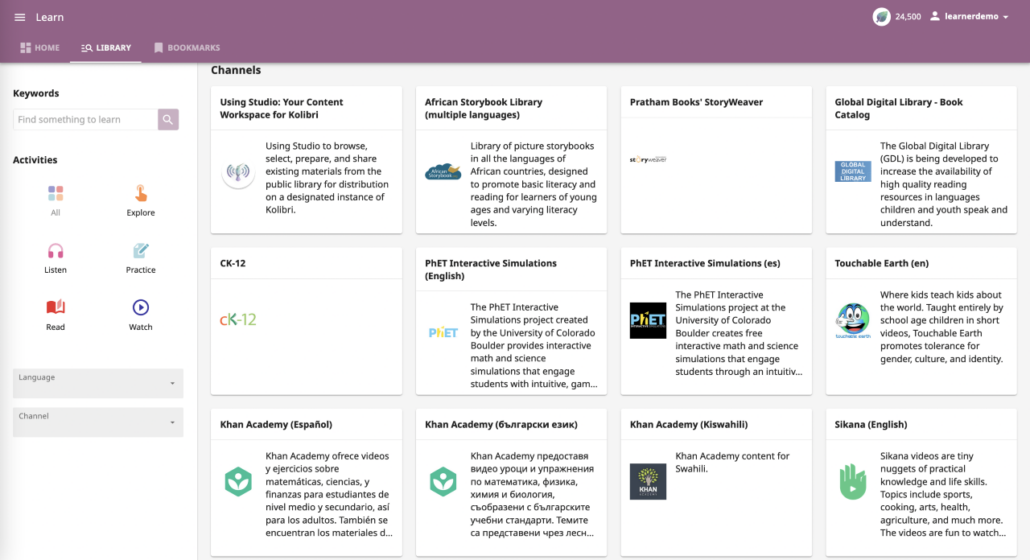
The practical consequence is significant. A teacher managing a large class in a refugee settlement, with limited preparation time and no internet access, can now build a structured, curriculum-aligned course from a library of hundreds of thousands of resources without spending days doing it manually. The AI is not teaching students, but removing a bottleneck that would otherwise make the library effectively unusable for those who need it most.
Since 2018, the Kolibri FLY program, run in partnership with UNHCR and the Vodafone Foundation, has brought the platform to refugee and host communities across Kenya, Uganda, Tanzania, Jordan, Mozambique, and South Sudan. Documented outcomes include improved test scores in Honduras, stronger educator confidence in India, and measurable gains in learner confidence in Sierra Leone.
What Kolibri demonstrates is that the teacher’s role does not shrink when AI enters the room. It clarifies. The teacher remains the person who knows the students, sets the tone, and makes the judgment calls. The AI handles the part of the job that used to eat hours without adding educational value: sorting through an overwhelming library to find what is actually relevant. When that burden lifts, the teacher can focus on teaching.
Brazil’s public education system serves an enormous and economically diverse population, and the gaps in learning outcomes between public and private schools remain wide. Geekie, an edtech company founded in São Paulo, has built an adaptive learning platform designed specifically to address those gaps.
The platform uses machine learning to assess each student’s learning profile and generate a personalised study path. It identifies gaps in real time and adjusts the difficulty and format of exercises accordingly. For teachers, it provides data on which students are falling behind and in which specific areas, reducing the guesswork that comes with managing large, heterogeneous classes.
Geekie does not position itself as a replacement for teachers. The data it surfaces is only useful insofar as a teacher acts on it. The platform has been certified by Brazil’s Ministry of Education and has reached more than 12 million students across 5,000 schools. Approximately 82% of its registered users are students in public schools, which reflects both the scale of need and the platform’s deliberate focus on equity over premium positioning.
The company operates a one-for-one model: for every private school that purchases its services, it provides the same product to a public school. That structural choice shapes what Geekie actually is: less a tech product and more an attempt to use technology as a redistribution mechanism within an unequal system.
The students who benefit most from Geekie are not the ones at the top of the class, but the ones lagging behind, in ways a teacher managing forty students could not always detect in time. Personalised learning at scale means that a child who struggles with a specific concept receives targeted support for that concept, rather than a generic review of the whole topic. That kind of individual attention has historically been available only to students whose families could afford private tutoring. Geekie does not replicate the private tutor, but it makes the teacher more effective with every student in the room simultaneously.
In many rural schools across sub-Saharan Africa, the teacher is the only resource in the room. There are no textbooks for every student, no supplementary materials, and no way to look something up. When the teacher does not know the answer or does not have time to prepare a structured lesson, the gap simply stays open.
Camara Education, an Irish nonprofit operating since 2005, has spent two decades addressing the hardware side of that problem, supplying refurbished computers to schools across Ethiopia, Kenya, Tanzania, and Zambia, and training teachers to use them. To date, it has installed over 135,000 computers in more than 12,500 schools, reaching around 4.5 million children. The computers run curriculum-aligned content locally, without requiring an internet connection, using the same offline-first logic that underpins Kolibri.
In 2025, Camara took that infrastructure a step further by deploying an offline AI assistant across its network. The Camara AI Assistant runs locally on the computers already installed in its school centres, with no internet required. It generates lesson plans, quizzes, and topic explanations aligned to national curricula, and is designed to support both teachers and students directly. A teacher preparing a science lesson can ask the assistant to generate a structured plan. A student who does not understand a concept can ask it to be explained in a different way.
This is not a minor incremental upgrade. For a teacher managing fifty students in a classroom with no connectivity and limited preparation time, access to a tool that can generate curriculum-aligned lesson plans on demand changes what is practically possible in a school day. The AI does not replace the teacher, it gives the teacher something to work with.
Camara’s network now covers 13,000 schools across its four operating countries, with 72,000 teachers trained on its systems. The AI assistant program is in early rollout, but the foundation it sits on, two decades of hardware deployment, teacher training, and local hub infrastructure, means it is not starting from scratch. It is adding a new capability to an existing, functioning system.
The Camara case makes the displacement argument hard to sustain. No teacher is being replaced here. Instead, teachers who previously had one resource now have two. In classrooms where the baseline was close to nothing, AI is not in competition with existing support structures. It is, in many cases, the first structured support that teachers have ever had access to.
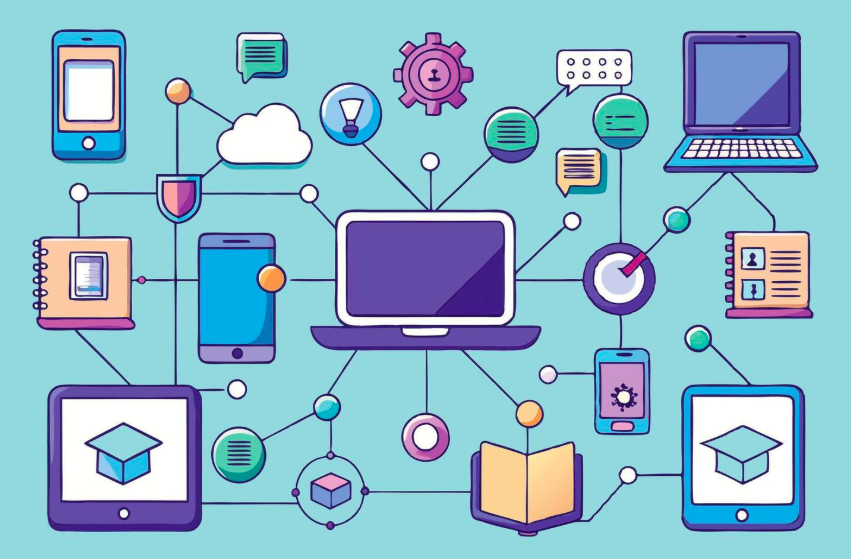
These three projects are different in geography, method, and scale, but they point in the same direction. Kolibri gives teachers in disconnected communities access to a vast, curriculum-aligned library they could not otherwise navigate. Geekie gives teachers in under-resourced Brazilian classrooms the kind of student-level insight that was previously available only in well-staffed private schools. Camara gives teachers in rural Africa a capable assistant, where there was none before.
The fear that AI will replace teachers gets the problem backwards, at least in the contexts in which these projects operate. The classrooms that need the most help are not those where teachers are being outcompeted by technology. They are classrooms where teachers have been asked to do an impossible job with almost nothing. AI does not change who is responsible for education in those rooms. It changes what is available to the person who is.
That is not a small thing. For the 273 million children currently out of school, and for the many millions more sitting in classrooms without adequate support, the question has never been whether AI poses a philosophical risk to pedagogy. It has been a question of whether anyone was going to show up with something useful. These projects suggest that in some places, at least, the answer is starting to be yes.
Author: Slobodan Kovrlija