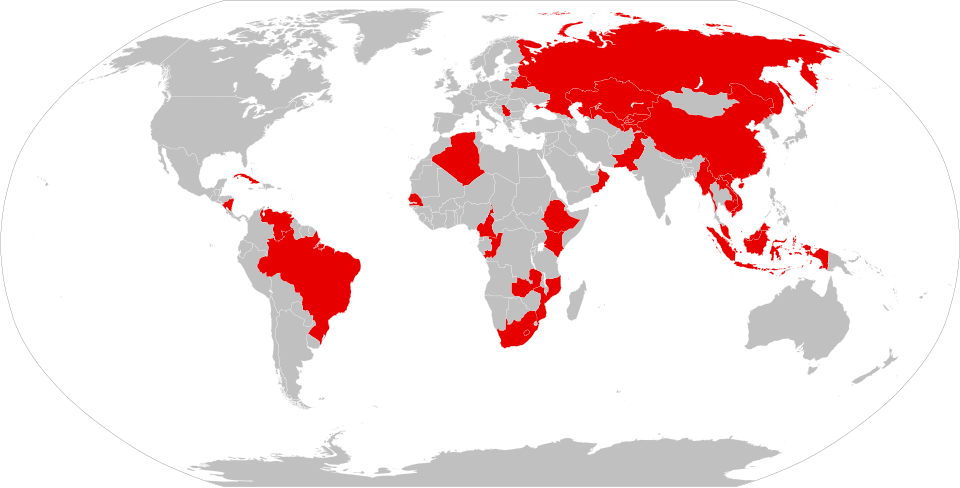
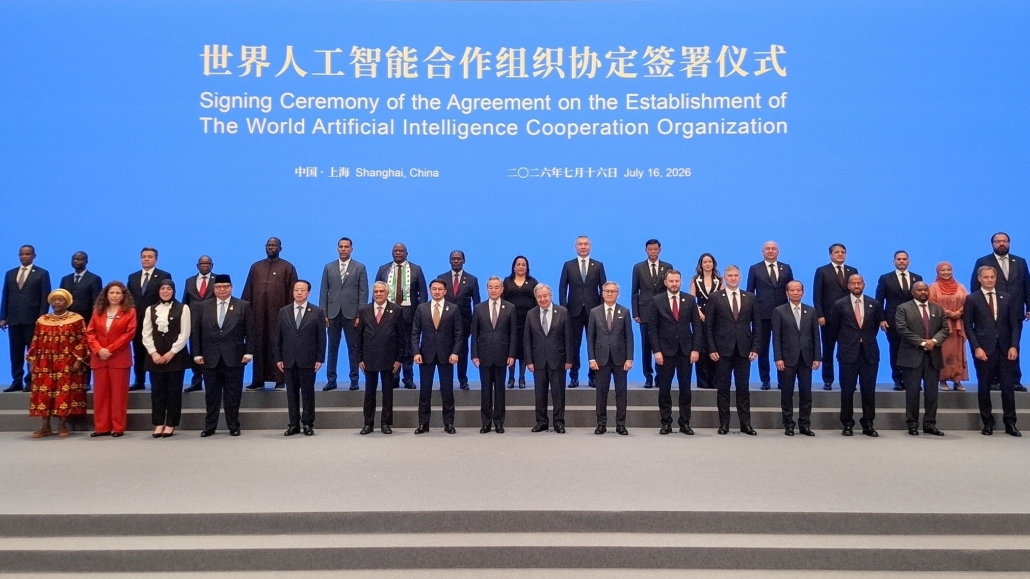
July 2026 saw a significant development in global AI governance. On 16 July, 29 countries signed the agreement establishing the World Artificial Intelligence Cooperation Organisation (WAICO), an intergovernmental body headquartered in Shanghai and presented as a platform for international cooperation, capacity-building, and ‘beneficial, safe and fair‘ AI development. The signing took place on the eve of the World Artificial Intelligence Conference, which then ran from 17 to 20 July. Earlier in the month, Geneva hosted the UN’s inaugural Global Dialogue on AI Governance alongside ITU’s AI for Good Global Summit and the WSIS Forum, creating a separate but related week of discussions on cooperation, standards, and AI governance. These events used similar language about inclusion and benefits for all, but they pointed to different institutional paths. In this article, we examine what WAICO is, how it relates to Geneva’s process, and why the distinction is important for international organisations shaping AI policy and procurement. WAICO is the first intergovernmental organisation dedicated to AI cooperation. It was first proposed by Chinese Premier Li Qiang at the 2025 WAIC and formally established in Shanghai on 16 July 2026. Its charter states a people‑centered approach and a mandate to promote international cooperation, develop cross‑border AI regulation, and ensure AI is beneficial, safe, and fair for all under UN Charter principles. The secretariat will be headquartered in Shanghai. The organisation’s founding package included concrete capacity‑building and standards components. China pledged 5,000 AI training and seminar slots over five years and the creation of AI cooperation centres with regional bodies, including ASEAN, the African Union, the League of Arab States, CELAC, the Shanghai Cooperation Organisation, and BRICS. Separately, 30 countries agreed to adopt China’s MAZU AI meteorological warning system, presented as a public‑good application of AI for disaster prevention. At the opening ceremony, President Xi Jinping framed the initiative as a “symphony of international cooperation”. He also warned against “overstretching the national security concept” in AI, a phrase widely read as a critique of export‑control and security‑first policies that limit access to advanced models and hardware. Founding membership includes countries from Asia, Africa, Europe, and the Americas, including Belarus, Russia, Serbia, Brazil, Cuba, Nicaragua, and Venezuela. Analysts note that WAICO marks China’s shift from articulating principles (as in its 2023 Global AI Governance Initiative) to building a permanent institution with a secretariat, membership pipeline, and training programs.
The Global Dialogue on AI Governance was created by UNGA resolution A/RES/79/325 and held its first session in Geneva on 6–7 July 2026, back‑to‑back with ITU’s AI for Good Global Summit (7–10 July) and the WSIS Forum. Its mandate is to serve as a universal, inclusive platform where all governments, the private sector, academia, and civil society can discuss cooperation, capacity‑building, and the interoperability of governance approaches. Thematic clusters covered AI opportunities and implications (social, economic, ethical, cultural, linguistic, technical), bridging AI divides, and international cooperation and governance. The Dialogue’s preparatory report recorded wide consultation, including more than 1,500 written submissions, and highlighted divergent priorities: governments emphasised capacity‑building and development, while other stakeholders prioritised safety and risk management. One of the clearest policy messages from the AI for Good Summit week was that there is currently no international consensus to negotiate a global treaty on AI. In that context, Geneva functions as a forum for mapping positions and exploring coordination, not as a negotiating track for binding rules. The proximity of the two events is not accidental. Geneva set a universal frame for AI governance centred on procedure, rights‑adjacent language (human oversight, safety, accountability), and openness to multiple regulatory models. Shanghai took the same vocabulary and embedded it in a China‑anchored intergovernmental body with a physical secretariat, defined membership, and a capacity‑building pipeline. Where Geneva stresses consultation and interoperability, WAICO stresses delivery: training slots, regional centres, and turnkey systems like MAZU. This creates a practical question for international organisations: when inclusion is delivered through a specific institutional channel, what does that mean for autonomy, values, and long‑term dependency? Xi’s call to avoid “overstretching the national security concept” aligns with WAICO’s access‑oriented pitch. At the same time, Geneva’s dialogue leaves room for both rights‑based and development‑oriented approaches without committing to a single institutional vehicle. The result is a plural field in which states and IOs can participate in both tracks, but must assess the governance implications of each. Crucially, Geneva initiatives are multi-stakeholder (incorporating civil society and tech industry alongside states), whereas WAICO is explicitly intergovernmental and state-centric. Highlighting this contrast reinforces why non-state actors face different engagement strategies in each space. The institutional competition sits alongside technical and market shifts that also claim to serve the public interest. The open‑weight offensive of late July 2026 (including Moonshot’s Kimi K3 and DeepSeek V4) put powerful coding and reasoning models in the public domain with promises of free or low‑cost access. At the same time, ITU’s AI for Good Summit highlighted work on agentic AI security, testing and benchmarking, and infrastructure and energy dimensions of AI deployment. WAICO’s offers (training, regional cooperation centres, and public‑good applications) fit into this broader contest to define ‘good AI’ through skills, standards, and infrastructure, not only through rules. Also, China’s push for open-weight models acts as a major driver for adoption among emerging economies without reliance on US proprietary APIs. For international organisations, AI cooperation is often packaged with model access, training, standards participation, and sometimes turnkey systems. The governance challenge is how to ensure that such bundles remain interoperable, auditable, and aligned with an organisation’s own risk and ethics frameworks.
For IOs and diplomatic missions, the immediate task is to map where WAICO’s programs intersect with existing UN processes and regional standards. The EU AI Act’s high‑risk obligations became fully enforceable on 2 August 2026, while the Council of Europe’s Framework Convention on AI offers a rights‑based anchor for European neighbours. At the same time, the UN Dialogue will hold a second session in New York, continuing its role as a universal consultation platform. States and IOs can engage with WAICO’s capacity‑building and regional centres while maintaining alignment with UN processes and, where relevant, EU/CoE standards. Procurement and governance teams should treat capacity‑building offers as part of a larger dependency assessment. Key questions include data access and retention, standards ownership and voting rights, exit clauses, and interoperability with other systems. When ‘good AI’ is presented together with training and turnkey applications, the risk is not only technical lock-in but also normative alignment with the provider’s governance model. A practical checklist for IOs considering WAICO‑linked programs: Three developments will clarify how this dual track evolves. First, WAICO’s early working groups and standards initiatives, plus the rollout of its first regional cooperation centres, will show whether it functions as a technical body or a geopolitical platform. Second, the UN Dialogue’s second session in New York will indicate whether the process moves from consultation to concrete coordination mechanisms. Third, membership decisions by states that already participate in Geneva processes will signal whether fragmentation is hardening or whether pragmatic pluralism is possible. The takeaway is straightforward: AI cooperation is being organised through institutions, mandates, and cooperation mechanisms. Geneva and Shanghai are two visible examples, and together they raise a broader question of who sets the terms for AI cooperation, what values those terms reflect, and how states and international organisations should position themselves. Author: Slobodan KovrlijaWhat WAICO offers
The Geneva backdrop: a universal platform, no treaty
Two models of inclusion through institutions
Standards, open models, and market competition
Implications for international organisations and diplomats
What to watch next