In 2026, Switzerland will have to navigate a critical and highly uncertain AI transformation. With so much at stake and future AI trajectories unclear, the nation must build its resilience on a distinctly Swiss AI Trinity: Zurich’s entrepreneurship, Geneva’s governance, and communal subsidiarity, all anchored in the enduring values and practices outlined here.
Switzerland’s well-tested, evergreen principle of subsidiarity gains new relevance in the era of AI and digitalisation. As top-down AI hits its limits, subsidiarity can nurture bottom-up AI—anchored in local knowledge and context, and reflecting the real needs of citizens and communities.
Switzerland’s competitive advantage resides in the knowledge, expertise, and experience which can be leveraged for the AI era, by, among others, repurposing libraries, post offices, and community centres into AI knowledge hubs, running AI apprenticeship programmes, and introducing ‘AI for All’ small grants to develop local AI agents and platforms.
As a concrete proposal for digital subsidiarity, Antonio Gambardella, director of Geneva’s FONGIT, proposes the development of ‘Geneva stack’ as ‘a coherent set of sovereign digital tools progressively adopted by public administrations, schools, and institutions.’
Subsidiarity could also inspire a form of Swiss cyber militia system, providing a broad-based and decentralised capacity for cyber defence.
Switzerland has a long tradition of entrepreneurship centred on small and medium-sized enterprises (SMEs). This spirit is particularly vibrant in Zurich’s tech scene, home to a thriving mix of national and international AI pioneers. In 2026, the focus should be on nurturing this ecosystem—especially by fostering productive partnerships between nimble Swiss startups and global tech giants with major offices in the region, such as Google, IBM, and Microsoft. In addition, Switzerland should actively engage with a digital economy actors coming from India, Singapore, China, and other emerging economies.
Switzerland is a country with high trust capital, despite setbacks. One of Switzerland’s major challenges is how to translate its traditional trust capacity into the digital and AI realm amid increasing uncertainty.
While trust is often associated with cybersecurity, the question of trustworthy AI becomes increasingly relevant. It remains to be seen if Switzerland can become an international ‘AI verifier‘ by certifying the quality and reliability of AI systems.
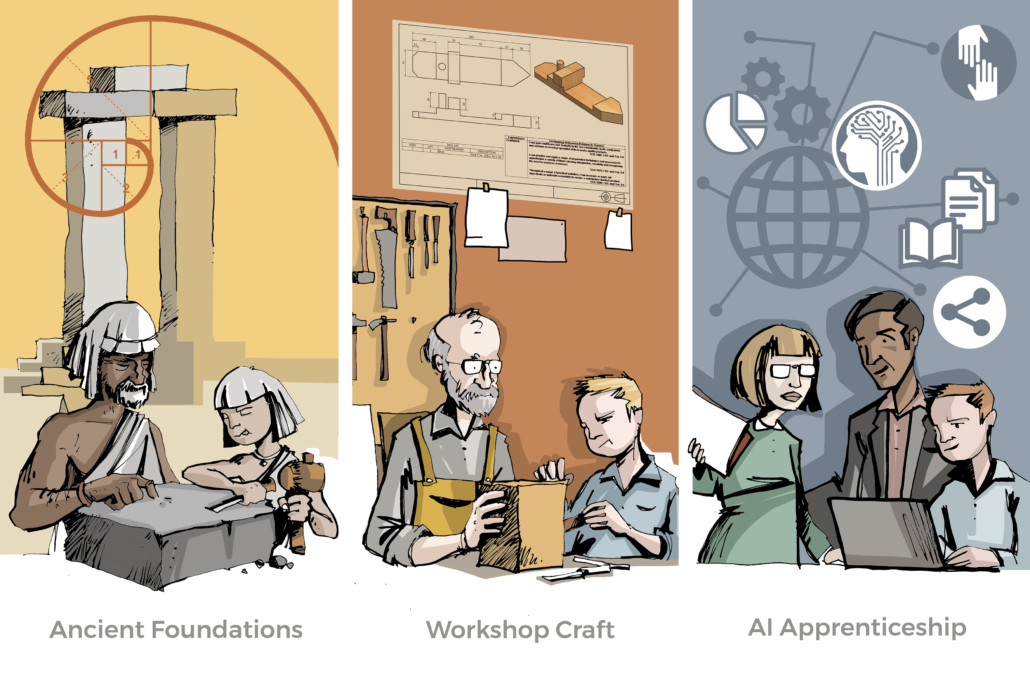
Apprenticeship, the Swiss pedagogical brand, is particularly suited for the AI era. Experiential learning, the core of the apprenticeship approach, is critical for grasping the probabilistic nature of AI.
Diplo has pioneered an AI Apprenticeship methodology of learning AI by developing AI, with four programmes attended by 124 apprentices over the last 12 months. The primary benefit is straightforward: abstract concepts—such as large language models, vectors, and neural networks—are grasped by building a concrete AI agent relevant to the apprentices’ work.
Switzerland can further capitalise on AI apprenticeships as a national brand and a distinctive contribution to preparing citizens and communities for AI transformation.
Topping the Global Innovation Index is a habit Switzerland must maintain. The challenge for 2026 is to harness this innovative capacity in two strategic directions that distinctly reflect Swiss values.
First, the country should deepen its excellence in small-scale, high-impact solutions. Beyond pursuing moonshots, it is uniquely positioned to lead in precision AI—developing targeted applications in medtech, fintech, and cleantech that solve specific problems with trademark Swiss efficiency.
Second, Switzerland must strategically embrace the global shift toward open-source AI, a movement now led by key global players. The 2025 launch of the Swiss LLM, Aperatus, was a good sign in this direction, which should be further expanded into a comprehensive suite of open-source tools across the entire AI lifecycle, including foundational models, localised solutions, and autonomous agents.
This year, discussions on neutrality will gain relevance ahead of the national referendum on the future of Swiss neutrality. Beyond traditional military and defence aspects, the new issue will become neutrality in digital and AI domains. Are cyber weapons covered by neutrality? What about the neutrality—or more precisely, the impartiality—of AI systems used and produced in Switzerland? These are some questions that Swiss academic and policy actors will have to address in 2026.
Quality, along with professionalism and solidity, is another Swiss brand that takes on new relevance in the AI era. The diminishing quality of AI services became so prominent that Merriam-Webster declared the word ‘slop’ as its Word of the Year 2025, inspired by the often careless output of AI platforms. The initial excitement that AI can generate a poem or essay is giving way to tougher expectations: relevance and high-quality inference.
Very often, better AI does not require more hardware or even new algorithms. It requires well-curated knowledge and data, and here, Switzerland can develop a new economic and policy niche.
Tell me where your data is, and I will tell you how digitally sovereign you are! Most Swiss data is stored outside the country, which is typical for most countries except China and the United States. Even the data of the International Committee of the Red Cross, a symbol of Switzerland, is kept on servers in Luxembourg. While achieving full digital sovereignty is almost impossible in a highly interdependent world, Switzerland—like other countries—has to make informed decisions about which digital assets to keep on its territory and which to share with the rest of the world.
In this context, the Swiss federal administration has identified digital sovereignty as one of its three key focus areas for implementing the Digital Strategy in 2026. In order to identify foreign and security risks, Switzerland has to have clarity on the physical location of digital assets, legal protection, and policy for their use. Once the holistic map of Swiss digital assets is ready, the country could explore a two-pillar approach to increasing digital sovereignty:
Sovereignty in the digital realm refers to the control exercised by (primarily) governments over tech infrastructure, digital platforms, and the collection and processing of data in specific territories. Digital sovereignty is exercised using tools ranging from the legal—court orders, for instance, and national regulations—to the technical, including internet shutdowns and data filtering. Approaches differ from country to country.
For instance, China has achieved an unusually high level of sovereignty with its legal requirement that Chinese citizens’ and organisations’ data be stored on Chinese territory (i.e. localisation). GAIA-X is the EU’s initiative for developing its own sovereign cloud and digital ecosystem. The EU has also extended its sovereignty worldwide by requiring that the data of its citizens be processed in ways compliant with the General Data Protection Regulation (GDPR) even outside the EU’s jurisdiction. Tim Berners-Lee’s Solid project focuses on the self-sovereignty of individual internet users over their own data and digital footprint.
It is well-documented that rapid technological growth deteriorates social cohesion, from families to communities and entire countries. Thus, the need for solidarity gains new relevance, especially when centralisation of AI and digital power widens existing societal and economic divides.
In 2026, Switzerland should adopt a solidarity approach by, among other measures, reskilling workers, supporting regions and industries in AI transition, and utilising digital tools to strengthen—not weaken—our social safety nets.
Digital systems are becoming the weakest points in many critical infrastructures, ranging from energy grids to railway networks and hospitals. New approaches to resilience are required. A major step is to revisit digital dependencies, particularly those that extend beyond national borders, and assess their associated risks. This will enable the gradual development of more resilient national structures as part of achieving digital sovereignty.
Switzerland cannot compete in the AI race for computing power. The good news is that this race will become less important as the dominant formula—’more Nvidia cards = better AI’—reaches a plateau with new LLM models providing marginal improvements and dimnishing returns. The AI race shifts to Swiss terrain of practical innovation centered around bottom-up AI anchored into the country’s knowledge and experience. The ten keywords above are not slogans—they are a practical compass for 2026, linking Zurich’s entrepreneurial drive, Geneva’s governance muscle, and the everyday strength of communal subsidiarity.
If Switzerland treats trust as infrastructure, apprenticeships as a strategic approach, quality as a competitive edge, and sovereignty as a calculated risk, it can turn AI uncertainty into an advantage. The choice is: import the future as a dependency, or build it as a capability—carefully, inclusively, and resiliently.