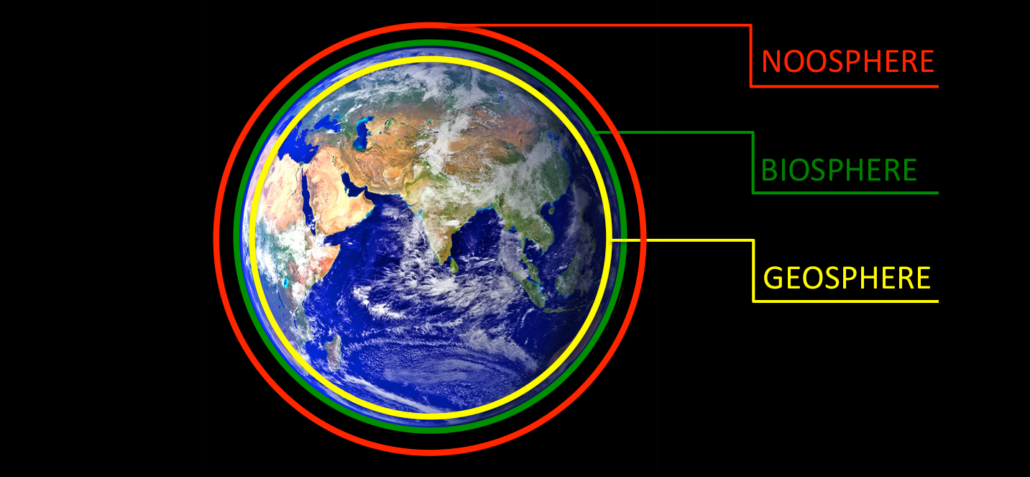
When we speak about nature, we often think first of forests, rivers, animals, mountains, and the living world around us. But nature is broader than the biosphere alone. It includes non-living spaces such as land, water, minerals, and atmosphere. It also includes the noosphere of human creativity and spirituality, according to Pierre Teilhard de Chardin, the French priest and philosopher, and Vladimir Vernadsky, a Russian scientist. AI impacts all three layers: the geosphere, the biosphere, and the noosphere. The geosphere is the physical Earth: land, water, energy, and minerals. The biosphere is the world of living beings: plants, animals, and humans. The noosphere is the sphere of human thought, knowledge, values, science, and spiritual reflection. Understanding AI’s relationship with nature means looking at all three spheres. AI frequently appears weightless. We experience it through screens, prompts, images, voices, and texts. But behind every AI system lies a vast physical infrastructure: data centres, cables, chips, servers, cooling systems, energy grids, and mineral supply chains. This is where AI becomes tangible and a material part of the geosphere. The most visible impact is the growing demand for energy and water. Large AI systems require enormous computing power for both training and inference. Data centres need electricity to run servers and water to cool processing units. This creates new pressure on local water resources, especially where water is already scarce. AI also depends on minerals and rare earth elements used in chips, batteries, sensors, and digital infrastructure. These resources are extracted from the Earth, often with significant environmental and social consequences. Mining, processing, and transport all leave ecological footprints. Thus, AI is not simply ‘cloud’ technology. The cloud has a geography. It has a geology. It has a hydrology. It uses land, water, minerals, and energy. The key question is not whether AI should use physical resources. All human technologies do. The question is whether AI can be developed with awareness of its material footprint. This means more efficient chips, renewable energy, responsible water use, better cooling systems, recycling of electronic waste, and greater transparency from AI companies about nature and environmental costs. The biosphere is the realm of life. Here, AI has both promising and problematic impacts. For plants and agriculture, AI can help monitor soil health, detect crop diseases, optimise irrigation, and reduce excessive use of fertilisers and pesticides. It can support precision agriculture, making food production more efficient and potentially less damaging to ecosystems. AI can also help track deforestation, monitor forests, and model the effects of climate change on plant life. For animals, AI is increasingly used in biodiversity monitoring. Camera traps, acoustic sensors, satellite images, and machine learning systems can help identify species, track migration, detect poaching, and monitor endangered habitats. AI can make visible what human observers often miss. It can listen to forests, oceans, and wetlands at a scale previously impossible. Yet there are risks. AI-driven industrial systems can also accelerate extraction, overfishing, wildlife surveillance, and intensive farming. Technology that helps protect nature can also be used to exploit it more radically. The ethical question is therefore not only what AI can do, but who controls it and for what purpose. For humans, being part of the biosphere, AI is already affecting work, education, health, communication, and social relations. AI can help diagnose diseases, improve accessibility, support scientific research, and expand learning opportunities. But it can also deepen inequality, manipulate attention, reduce human agency, and treat people as data points rather than dignified beings. One of the most fascinating intersections between AI and the biosphere is DNA. DNA is nature’s extraordinary information-storage system. Modern hard drives store data through magnetic or electronic patterns. DNA stores information through the biological code. It is incredibly dense, durable, and compact. Researchers have shown that digital information can be encoded into DNA and embedded into physical objects. At Stanford University, researchers on the Bunny project encoded information into DNA, protected within silica nanoparticles, mixed into plastic, and then used to 3D-print an object containing the information needed to recreate it. It signals further development of the ‘DNA of things‘ in which physical objects could contain their memory: medical implants carrying patient data, archival materials preserving information for centuries, or ordinary objects containing hidden digital records. This example illustrates a deeper point: AI is acting on nature and learning from it. Biology has already solved many problems that technology is now trying to address: storage, adaptation, resilience, pattern recognition, and self-replication. DNA reminds us that life itself is an information system, but one embedded in matter, evolution, and meaning. Beyond the geosphere and biosphere lies the noosphere: the sphere of human thought, knowledge, culture, science, and spiritual reflection. The concept has two major intellectual roots. The Russian scientist Vladimir Vernadsky saw the noosphere as the stage in which human scientific thought becomes a geological force shaping the planet. The French priest and philosopher Pierre Teilhard de Chardin gave the concept a more spiritual interpretation, seeing humanity’s collective consciousness as part of a larger evolutionary movement. AI now enters this noosphere with great force. On the scientific side, AI is changing how knowledge is produced. It helps researchers analyse data, discover patterns, generate hypotheses, simulate complex systems, and accelerate work in fields such as climate science, medicine, physics, and biology. AI can extend human cognition and help us navigate complexity. But it also challenges science. If AI systems generate texts, images, models, and conclusions without transparency, how do we verify knowledge? How do we distinguish certainty from probability, explanation from prediction, and truth from persuasive output? AI can support science, but it can also flood the knowledge space with synthetic content. On the spiritual and philosophical side, AI raises deeper questions: What makes humans unique? What is intelligence? Can machines understand meaning, or do they only process patterns? What happens to dignity, responsibility, and freedom when more decisions are delegated to algorithms? These and other questions are addressed in the Pope’s encyclical Magnifica Humanitas from May 2026. The noosphere is therefore not only about smarter machines. It is about wiser humans. AI may process information at an enormous scale, but wisdom requires judgement, humility, responsibility, and care for life. AI and nature should not be discussed only in terms of risk or innovation. We need a broader ecological understanding. At the level of the geosphere, AI depends on Earth’s material resources: water, energy, minerals, and land. At the level of the biosphere, AI affects living systems: plants, animals, humans, and even the biological code of DNA. At the level of the noosphere, AI reshapes knowledge, science, culture, ethics, and spiritual reflection. These three layers are connected. Energy use impacts the climate. Climate affects ecosystems. Ecosystems affects human life. Human knowledge affects technology. Technology, again, affects nature. The future of AI will therefore depend on embedding it within a broader natural context by addressing many critical questions. Can AI help us understand the Earth without exhausting it? Can it protect life rather than optimise its exploitation? Can it strengthen human wisdom rather than replace human judgement? Nature is not just a resource for AI. It is the condition of AI’s existence, the source of its deepest metaphors, and the ultimate test of its value. If AI is to serve humanity, it must also serve the wider web of life and the Earth that sustains it.
AI and the geosphere: The hidden materiality of intelligence
AI and the biosphere: Plants, animals, humans, and DNA
AI and the noosphere: Science, spirituality, and meaning
Towards an ecological understanding of AI