How symbolic math, rule-based systems, and databases power the AI that actually works and why the future is hybrid, not just ‘bigger LLMs‘. We have heard many complaints about how AI sometimes gives wrong answers even for obvious things, such as basic percentage calculations or simple unit conversions, and that this should be preventable. My immediate reaction was to wonder why rule-based approaches are not used to enforce correctness. That question reminded me that twenty years ago, as a university student, I was already working with software that could symbolically solve complicated equations, compute integrals and derivatives, and manipulate mathematical expressions with exactness. We used Mathematica and Matlab, and I was truly fascinated by what they were able to do. Today, with all the hype around Large Language Models (LLMs), it is easy to forget that the most impressive AI achievement in many technical domains is not the LLM at all. It is the deterministic tools that can manipulate symbolic mathematics and rules with guarantees. The real breakthrough is not in replacing those tools with LLMs, but in combining them. LLMs are powerful language interfaces, but they are not calculators, theorem provers, or rule engines. The future of AI is hybrid: deterministic cores wrapped in language-friendly interfaces. This idea aligns with recent observations by Dr Jovan Kurbalija in his article on AI diplomacy, Singapore’s ‘second brain’ concept, and the return of deterministic AI. Here, I want to focus on the engineering perspective, informed by my own experience with symbolic math tools and industrial AI. You have probably seen it yourself: someone asks an LLM a simple quantitative question, and the model confidently gives the wrong answer. ‘What is 15 percent of 80?‘. ‘Convert 37 degrees Celsius to Fahrenheit.‘ ‘Solve this basic algebra equation‘. For many people, this is frustrating but also puzzling. If AI is so advanced, why can it not handle obvious things? The reason is structural. LLMs are next-token predictors trained on massive amounts of text. They learn statistical patterns, not explicit rules. They do not ‘know‘ that 2 plus 2 must be 4. They learn that ‘4‘ is the most probable continuation in that context. They do not have an internal model of arithmetic or logic with hard guarantees. Contrast this with older deterministic tools like Mathematica, Matlab, or Maple. As a university student twenty years ago, I used these mathematical software tools to: These were not approximations or guesses. They were algorithmic, deterministic, and mathematically rigorous. To me, it is arguably more amazing that we built software that can symbolically manipulate mathematical expressions than that we built text predictors that sometimes guess the right answer. The problem is that most people do not even have a notion of symbolic expressions existing. To them, an LLM that can chat, explain formulas, or ‘talk like an expert’ feels like magic. The deeper engineering achievement is invisible.
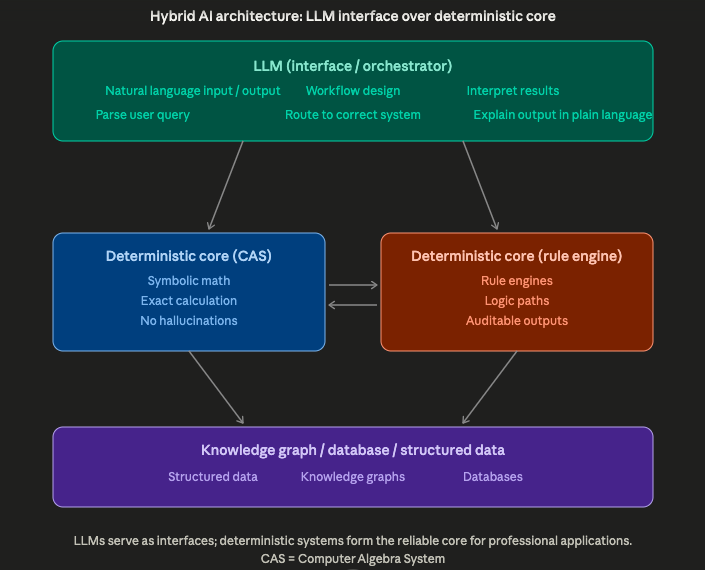
After all, for things to work properly, we want the outputs of our computer systems to be deterministic, not just probable. The bank needs correct numbers, not approximate ones. Machines in factories function on correct parameter values, not guessed ones. The robot in the factory needs to solder parts always at exactly the same spot, not to guess the most probable one each time. For many things in work and life, we need to know that the tools we use give us correct and factual outputs, not just most-likely ones. People often forget this because they do not realise that AI gives estimated outputs. It is built so that those estimated outputs are generally good, but not always. Life and the things humans build are far more complicated than 2 plus 2, and for more complicated things, we cannot rely on ‘most likely‘ guesses. In engineering, science, finance, law, and industrial automation, we need correctness, reproducibility, and guarantees. That is why deterministic tools matter. They give us exact results, not statistical approximations. CAS stands for Computer Algebra System. It is software designed to do symbolic math rather than just numerical calculations. A CAS can differentiate and integrate expressions symbolically, solve equations exactly instead of just numerically, simplify complex algebraic formulas, and perform series expansions, transforms, and more. Classic examples include Mathematica, Maple, and Matlab’s Symbolic Math Toolbox. Open-source options exist too, such as Maxima. What makes CAS special is that it works with expressions like ∫ x2 dx = x3/3, not just approximate numbers. It uses deterministic algorithms with provable correctness. It can simplify, transform, and reason about formulas in mathematically exact ways. LLMs, by contrast, deal in text and probabilities. CAS deals in symbols and rules. For math, physics, engineering, and many scientific domains, the latter is the real workhorse.CAS is an example of deterministic AI / rule-based systems that have been around for decades and are still the backbone of technical computing. As LLMs show their limitations, such as hallucinations, inconsistency, and lack of guarantees, there is renewed interest in deterministic approaches: This is not just my personal observation. In recent discussions about AI and diplomacy, particularly around Singapore’s approach, Dr. Jovan Kurbalija notes that the most useful AI is not just a giant LLM on its own. It is a mix of LLMs, structured data, rule-based systems, knowledge graphs, and search. This marks the return of deterministic AI alongside LLMs. In domains where accuracy matters, such as treaty interpretation, sanctions, or procedural rules, deterministic systems reduce hallucinations and make outputs auditable. He also highlights Diplo’s ‘AI Pareto paradox’: 80% of attention and resources go to frontier LLMs, but in many professional contexts, they deliver only a minority of the practical impact. The real value often comes from simpler, integrated deterministic systems. This matches my intuition from an engineering perspective. Deterministic tools have been doing heavy lifting for decades. LLMs are a new, powerful interface, not the core engine. LLMs are impressive, and for good reason. They understand and generate natural language, summarize large texts, explain complex ideas in plain language, and are accessible to anyone without technical training. That accessibility is itself a genuine achievement. The underlying symbolic and rule-based systems that power technical computing have always been less visible, not because they are less significant, but because they were never designed to talk to you. An LLM speaks your language. A CAS does not. It is natural that one feels more magical than the other. LLMs and deterministic systems are impressive for different reasons: one for accessibility and language, the other for depth and correctness. The future is not ‘LLMs versus deterministic systems’. It is LLMs plus deterministic systems. LLMs act as interfaces and orchestrators, while deterministic components do the heavy lifting. A typical hybrid architecture works like this. The LLM front end understands natural language and maps user questions to formal queries, rules, or workflows. The deterministic back end includes a CAS or symbolic math engine for equations and calculus, rule engines for business logic, policies, or procedures, databases and knowledge graphs for structured facts, and numerical solvers for physics, engineering, and optimization. Finally, the LLM back end takes the exact result and explains it in plain language, providing context, examples, and reasoning. Consider a math question. The user asks, ‘What is the integral of x2 from 0 to 1?’ The LLM parses the question and calls a CAS. The CAS computes exactly ∫01 x2 dx = 1/3. The LLM then explains the result in words and connects it to the user’s context. In industrial AI or engineering, the LLM interprets a maintenance request or operational query, the rule engine checks policies, constraints, and procedures, a simulation or solver computes outcomes, and the LLM reports back in natural language. This is exactly how Singapore’s diplomatic ‘second brain’ tools are built, with LLMs for natural language and workflow, and structured data, knowledge graphs, and rules for precision and auditability. The real breakthrough is that this combination gives us human-friendly language with mathematically and logically guaranteed results. It avoids the problems of letting LLMs ‘do the math’ on their own. If hybrid systems are the better approach, why do we still see so many pure LLM failures? Pure LLM chatbots are easy to build and demo, and ‘biggest model’ is a simple, catchy narrative. Wiring LLMs to robust back ends is harder engineering work. Many consumer-grade tools expose only the LLM front end, so users see the LLM as ‘the AI’, not the whole system. The hype cycle keeps media and investors focused on frontier LLMs, while deterministic systems are less exciting but more reliable. The failures you see, such as incorrect math or hallucinated logic, are not proof that AI is broken. They are proof that we are still in the early phase of building proper hybrid systems.
For engineers and technologists, the message is clear. Do not treat LLMs as all-purpose reasoners. Design systems where LLMs are interfaces, not the core logic. Invest in deterministic components such as CAS, rule engines, knowledge graphs, and databases. For professionals, not just AI specialists, the key is to learn to work with hybrid systems. Understand how to call solvers, use structured data, and apply rules. Use LLMs to help you design workflows and interpret results. For policy and governance, regulators and diplomats should not focus only on LLMs. They need to understand how AI systems are actually built, including deterministic components. This aligns with the ‘AI apprenticeship‘ idea for diplomats: they should build and use AI, not just be briefed on it.
For engineers and technologists, the message is clear. Do not treat LLMs as all-purpose reasoners. Design systems where LLMs are interfaces, not the core logic. Invest in deterministic components such as CAS, rule engines, knowledge graphs, and databases. For professionals, not just AI specialists, the key is to learn to work with hybrid systems. Understand how to call solvers, use structured data, and apply rules. Use LLMs to help you design workflows and interpret results. For policy and governance, regulators and diplomats should not focus only on LLMs. They need to understand how AI systems are actually built, including deterministic components. This aligns with the ‘AI apprenticeship‘ idea for diplomats: they should build and use AI, not just be briefed on it. Author: Slobodan Kovrlija
The LLM that cannot do basic math

Why we need deterministic outputs in real life
What is a CAS and why it is important
The return of deterministic AI
Why LLMs are still ‘wow’ to most people
The real breakthrough: hybrid systems
Implications for engineers, professionals, and policy

Implications for engineers, professionals, and policy