In 2025, Diplo Academy advanced and strengthened diplomatic and governance capacity in a changing digital environment. The year was characterised not only by steady participation but by deliberate refinement: adapting learning formats, deepening institutional engagement, and investing in teaching methods suited to AI-shaped professional realities. Across online courses, institutional training, and flagship innovation in AI education, Diplo Academy focused on one central question: how can learning remain rigorous, practical, and inclusive for professionals operating under increasing time and policy pressures?
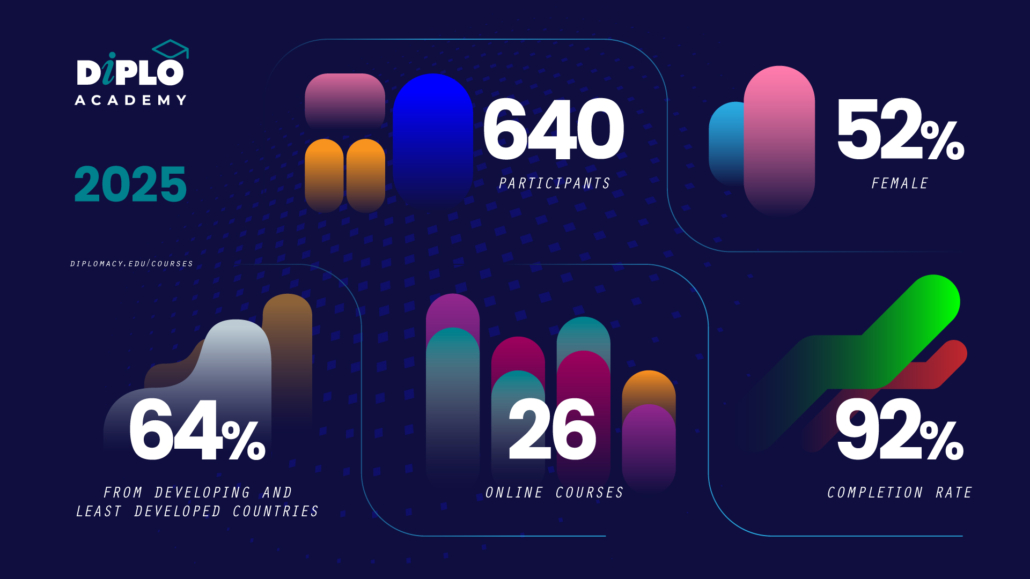
Diplo Academy’s online learning programmes continued to attract a diverse and engaged global audience throughout 2025. Over the year, 26 online courses were delivered to 640 participants. Women accounted for 52% of learners, while 64% came from developing and least developed countries – figures that reflect Diplo’s continued emphasis on inclusive access to capacity development.
Equally significant was a completion rate of 92%, pointing to strong learner motivation and effective course design. By the end of 2025, Diplo Academy’s alumni network exceeded 8,200 members, forming a broad and active community of practitioners working across diplomacy, digital policy, and governance worldwide.
Responding to the realities faced by busy professionals, Diplo Academy began restructuring its long-standing eight-week online courses into more compact four-week formats. This ongoing transition is designed to make learning more accessible without diluting intellectual depth, practical relevance, or learning outcomes.
The revised structure prioritises better engagement, focus, and usability. Core concepts, applied exercises, and peer exchange remain central, while pacing is adapted to fit demanding professional schedules. The redesign preserves Diplo Academy’s emphasis on reflective learning and skills that can be immediately applied in professional contexts.
Explore the evolving course offer and recent updates at the Course Catalogue page.
In 2025, Diplo Academy complemented its courses with a focused programme of in situ and online training tailored to institutional needs. Eight training activities reached 225 participants, hosted by partner organisations and Diplo, demonstrating Diplo Academy’s ability to translate conceptual expertise into institution-specific learning experiences.
These engagements addressed concrete challenges faced by institutions. Programmes included training on implementing AI in daily work for the EU staff in Geneva, public diplomacy training for the EU delegation to the United States, and institutional AI transformation at the Polish Diplomatic Academy. Additional initiatives covered data protection and access to information in Serbia, digital democracy capacity development in Armenia, executive education in EU diplomacy, and a programme on governing the digital age.
A defining development in 2025 was the continued expansion of the AI Apprenticeship course as Diplo Academy’s flagship programme. Three editions were delivered during the year, including one designed specifically for Geneva-based international organisations.
The course addresses a critical institutional gap: how to transition from abstract AI discussions to the responsible and informed use of AI in everyday professional practice. Participants engage directly with AI tools while examining governance frameworks, ethical considerations, and organisational implications, ensuring that technical experimentation is anchored in policy awareness and public responsibility.
The AI Apprenticeship is founded on a learning philosophy rooted in the Swiss apprenticeship tradition. This model emphasises learning by doing, guided mentorship, and critical thinking as a means of transmitting experience and institutional wisdom.
Rather than positioning AI as a purely technical domain, the approach integrates judgement, responsibility, and context. Participants work on real-world challenges drawn from their professional environments, supported by peer exchange and expert guidance. In an era of rapid technological change, this methodology helps preserve human agency and institutional memory alongside innovation.
Alongside pedagogical innovation, Diplo Academy continued to invest in improving its online learning platform throughout 2025, resulting in a learning environment that supports high-quality teaching while enhancing the overall participant experience. Ongoing enhancements focused on supporting engagement, interaction, and usability for both participants and lecturers.
New and refined features were developed to align more closely with Diplo Academy’s teaching methodology, enabling richer discussion, smoother facilitation of course activities, and better integration of applied exercises. These improvements were not generic platform upgrades, but targeted developments shaped by years of teaching practice in diplomacy and digital policy.
Beyond structured training, Diplo Academy also contributed to broader capacity development initiatives in 2025. These included programmes advancing ethical and practical approaches to AI in diplomacy and governance in the Gulf, as well as a global dialogue linking AI governance with philosophy and ethics.
Such initiatives reinforced Diplo Academy’s role as a space for reflection and exchange, complementing skills-based learning with a longer-term perspective on governance, responsibility, and public interest in the digital age.
The developments of 2025 reflect a clear strategic direction for Diplo Academy: adapting learning formats to professional realities, embedding AI literacy through practice, and strengthening the infrastructure that supports high-quality education.
As diplomacy and governance continue to evolve under the influence of AI and digital transformation, Diplo Academy remains dedicated to learning that is accessible, grounded, and oriented towards real-world impact.