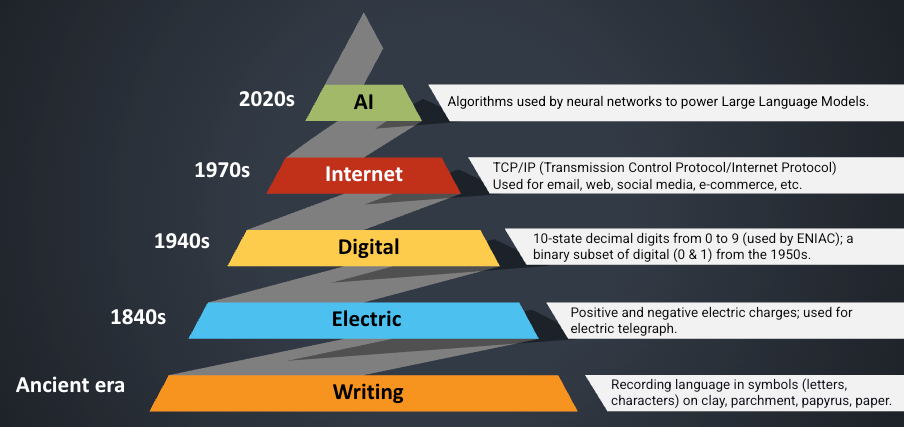
There is no better place and time to present my book on the History of Diplomacy and Technology than the International Telecommunication Union (ITU) on the organisation’s 161st anniversary. So many of the questions I covered in the book were negotiated in ITU’s corridors over the last 161 years. This long history does not offer ready-made lessons, but it provides inspiring rhymes that can help us understand today’s negotiations on technology and AI with greater depth, humility, and imagination. Technologies have changed dramatically since the age of the electric telegraph, yet many core policy dilemmas remain remarkably constant: security and privacy, freedom of communication versus national sovereignty, standardisation and regulation, innovation and control. In presenting the evolution of history and diplomacy of the ITU and far beyond to the ancient era, I introduced a 3×3×3 methodology centred around three time layers, three key technologies, and three vectors of technological impact on diplomacy. The temporal approach draws on the historian Fernand Braudel and his distinction between three layers of history: événement, conjoncture, and longue durée. The first layer, événement, concerns short-term events: military battles, landmark treaties, major diplomatic conferences, and political turning points. The second layer, conjoncture, focuses on medium-term trends. These are the deeper economic, social, political, and technological processes that unfold over decades or centuries and shape the context in which diplomatic events take place. The third layer, the longue durée, examines slow-moving historical patterns over centuries and millennia. It helps us identify what remains constant in statecraft even as technologies transform. Geography is one such persistent determinant. Modern digital submarine cables often follow the paths of nineteenth-century telegraph cables, which in turn traced much older maritime routes. In the long evolution of diplomacy and technology, three technological turning points stand out: writing, electricity, and digitalisation. Each transformed two essential pillars of diplomacy: communication and information. Writing enabled the transmission and preservation of diplomatic messages with greater accuracy. Electricity, through the telegraph and later radio and telecommunications, compressed distance and accelerated diplomatic communication. Digitalisation has brought further transformation, reshaping not only the speed and reach of diplomacy but also the relationships among diplomats, political leaders, experts, the media, and the wider public. Digitalisation comes to us via two latest technologies: the internet and AI. Technology affects diplomacy through three main vectors: the geopolitical environment, diplomatic agenda topics, and diplomatic tools. The first vector is the geopolitical environment. Technology shapes the distribution of power. Britain’s dominance over submarine telegraph cables gave it significant strategic influence in the nineteenth and early twentieth centuries. Today, geopolitical competition, especially between the United States and China, is increasingly a race for technological dominance across AI, 5G, semiconductors, and digital infrastructure. The second vector concerns diplomatic topics. New technologies generate new issues for negotiation. The ITU itself was established to facilitate the cross-border transmission of telegraph messages. Since then, the diplomatic agenda has expanded to include questions of spectrum management, standardisation, cybersecurity, privacy, connectivity, digital inclusion, satellite communications, and now AI. The third vector is diplomatic tools. Technologies also change how diplomacy is practised. The invention of writing is closely linked to diplomacy. In the Sumerian epic Enmerkar and the Lord of Aratta, writing emerges because envoys needed to transmit messages accurately, beyond the limits of human memory. Centuries later, the printing press helped Cardinal Richelieu establish France’s first ministry of foreign affairs, centred on archives and systematic information management. During the Cold War, radio became a powerful instrument of public diplomacy. Today, the diplomatic toolkit includes social media, video conferencing, data analytics, and increasingly AI. AI will not replace diplomacy. But it will augment diplomatic work by supporting research, analysis, drafting, translation, scenario-building, and institutional memory. As always, the key question is not only what technology can do, but how wisely diplomats use it. Semper idem, a Latin saying which means ‘always the same’, echoes across the history of diplomacy and technology. The technologies change, but many policy dilemmas remain familiar. The tension between freedom of communication and national security has been present on the ITU agenda since the 1875 St Petersburg Conference and continues to resonate today. Standardisation, interoperability, sovereignty, access, control, and trust have also run through ITU’s history in different technological forms. This continuity should not make us pessimistic. On the contrary, it should give us confidence. Diplomats have dealt with technological disruption before. They have negotiated uncertainty, managed competing interests, and built institutions to govern new forms of connectivity. ITU’s spiritus loci—built over 161 years of technological and diplomatic history—is a valuable resource for future tech negotiations. This history should shift from archives and anniversaries to practice as inspiration for negotiators and policy-making as a reminder that today’s digital and AI debates are part of a much longer human story. Technologies will continue to change. Diplomacy will continue to adapt. But many policy issues, approaches and rules remain – semper idem.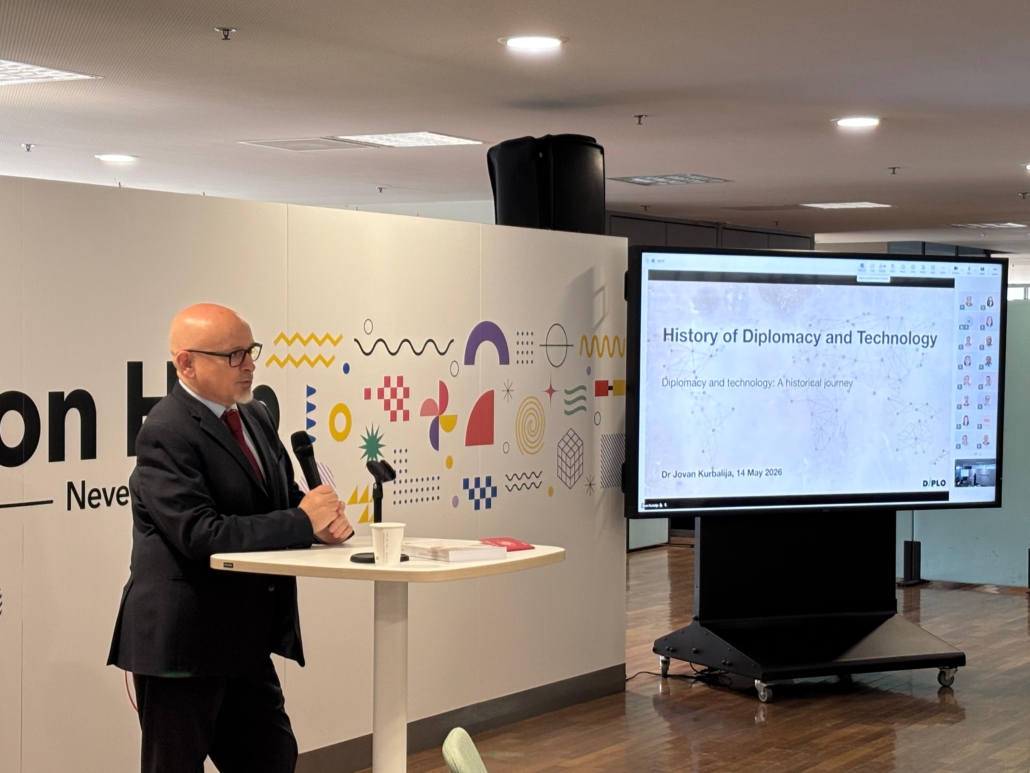

Three time layers

Three technologies
Three impact vectors
Semper idem
History and the ITU