Recent surveys show a clear pattern: people around the world do not share the same views on artificial intelligence. In much of Asia-Pacific, especially in emerging economies, AI is often seen as a chance for growth and progress. Meanwhile, in Europe and North America, people are more cautious or even sceptical, often worried about job losses, loss of control, and greater risks to society. At first, these differences might seem cultural or ideological. But looking closer, it becomes clear that people react to how AI affects their daily lives. In many parts of Asia-Pacific, people see AI improving public services, digital infrastructure, and economic growth. It feels like a step forward in modernisation. In much of the West, though, people often see AI in cost-cutting, automation, and in areas where trust is already low, like customer service, media, and online content. The result is not simply a difference in opinion, but a difference in meaning. The same underlying technologies (automation, recommendation systems, generative models) are interpreted through distinct economic and institutional lenses. Where AI aligns with visible progress, it is more readily embraced. Where it is associated with disruption or degradation of existing systems, scepticism follows. If we want to understand public opinion and make sense of the new friction points in global AI rules, we have to grasp this split. The 2025 AI Index Report makes the regional divide stark. In China, 83% of respondents see AI products and services as more beneficial than harmful; in Indonesia, 80%; in Thailand, 77%. In contrast, optimism remains far lower in Canada (40%), the United States (39%), and the Netherlands (36%). The UK government’s international survey on AI safety found a similar pattern. In Canada, France, Germany, the UK, and the US, the largest share of respondents believed AI had more risks than benefits. In Singapore and South Korea, the majority saw more benefits than risks. Deloitte’s Southeast Asia research added that 77% of Southeast Asians think generative AI will enhance social outcomes, and 69% believe it will increase Asia Pacific’s role in the global economy. Meanwhile, Pew-based reporting from 2025 showed that about half of Americans were more concerned than excited about AI, with only 10% reporting more excitement than concern. Americans were more open to AI in practical tasks like weather prediction or fraud detection, but far more resistant to AI in relationships, religion, and creative work.
In many areas of Asia-Pacific, the past few decades have brought fast growth, more digital technology, and better living standards. People there see technology as a sign of progress, not just job loss. AI is viewed as the next step in this journey. Automation brings better industries, new jobs, and economic improvement. In the West, however, automation is often linked to factory closures, jobs moving overseas, and people losing their jobs. The same technology brings up memories of growth in one place and decline in another. A factory worker in Vietnam may see AI as a pathway to higher-value industry, while a worker in the US Rust Belt may associate automation with layoffs and outsourcing. In many Asia-Pacific countries, people are more open to government-led planning and strategies. AI is seen as a tool to make the country more efficient, safe, and competitive. Governments in places like Singapore, the UAE, China, and South Korea promote AI as part of their national development plans. In the West, people are more sceptical of big systems like governments, companies, and online platforms. There, AI is often seen in terms of surveillance, bias, and corporate control. This leads to two different stories: one sees AI as national improvement, the other as a possible risk to society. In Singapore, AI is promoted alongside smart-city initiatives and efficient public services; in the US, similar technologies are more often discussed in terms of surveillance and privacy violations. Western media often focuses on major risks, ethical issues, job losses, and the misuse of AI. In many Asian countries, the media highlight innovation, adoption, and how AI helps the country compete. People tend to follow these messages: stories about risks make people less excited, while stories about progress make them more supportive. A chatbot replacing a call-centre agent symbolises declining service quality and job loss in the West, but in a rapidly digitising economy, it may symbolise access, scalability, and modernisation. These trends are stronger because of differences in age and technology use. Many Asia-Pacific countries have younger populations who use smartphones and digital services every day. They are used to apps, online banking, and fast delivery powered by AI. For them, AI feels like a normal part of life, not a big change. In the West, people often run into problems with AI, like chatbots that do not help, automated moderation, spam, and too much online content that makes things harder. This shows that people’s views on AI are often shaped more by their trust in the groups using it than by the technology itself. People judge AI based on how much they trust their governments, employers, markets, and online platforms. If these groups are seen as helpful, people are more likely to trust AI. If they are seen as failing, people become more suspicious of AI too.
This split does more than just mess with opinion polls. It drives how countries team up to build political coalitions around AI. Countries with greater optimism in public discourse tend to adopt AI more quickly and have fewer rules. More sceptical countries prefer stricter rules and more oversight. This causes disagreements when setting global standards, as groups like the OECD, EU, ASEAN, and China all start from different positions. In Europe, there are more demands for rules based on risk and for slowing down AI development. In the US, companies have been able to use AI quickly with little oversight, but people are still sceptical. Many Americans see AI as something that helps the rich and powerful, while regular people lose their jobs and receive worse service. In many Asia-Pacific countries, on the other hand, governments treat AI as a key part of their national plans and actively encourage its use for development. Global AI governance is both a technical coordination problem and a clash of socio-economic narratives about the future. Before governments can align AI systems, they may first need to recognise that societies are not trying to optimise for the same future. For some, AI represents acceleration; for others, it represents disruption. Global governance efforts must account for both realities. Ultimately, the East–West drift in AI optimism reflects differing levels of technological adoption and expectations about how the gains from AI will be distributed and experienced. Where AI is associated with broad-based improvements in income, services, and state capacity, it tends to be read as progress. Where it is associated with concentrated gains and diffuse disruption, it tends to be read as risk. Any attempt to build global AI governance frameworks will therefore need to address technical alignment alongside underlying differences in perceived fairness and shared benefit. Author: Slobodan KovrlijaThe data behind the divide
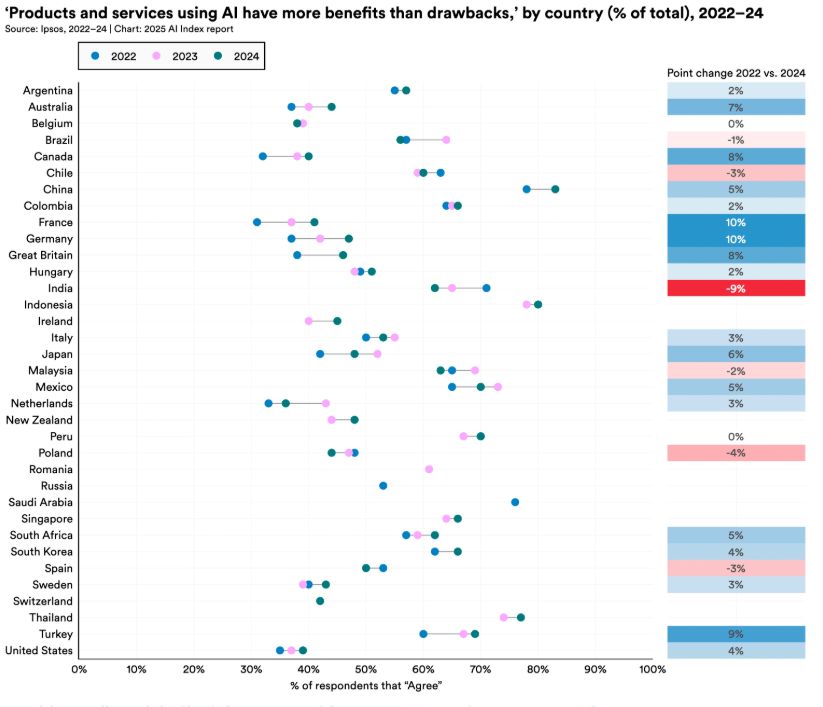
Source: Stanford HAI 2025 AI ReportThree deeper reasons for the split
1. Economic trajectory and lived experience
2. Governance, trust, and risk
3. Media, discourse, and digital life

From sentiment to governance