For a few months, it was everywhere. OpenClaw appeared across LinkedIn, X, Medium, Facebook, and the broader AI feeds from roughly November 2025 through March this year. Its name evolved almost as fast as the hype: it started as Clawdbot, briefly became Moltbot after a trademark scare, and finally settled on OpenClaw by the end of January. It was framed as ‘the AI that actually does things’: clearing inboxes, sending emails, managing calendars, and even checking people in for flights, often from within familiar chat apps like WhatsApp or Telegram. Then, by June, the volume of hype was a fraction of what it had been. The technology did not vanish, and the stack did not suddenly stop working. The conversation simply moved on in a way that felt strangely abrupt. What stands out is how quickly people mistake good language and slick demos for genuine capability. Agentic AI may be the clearest example of that so far.
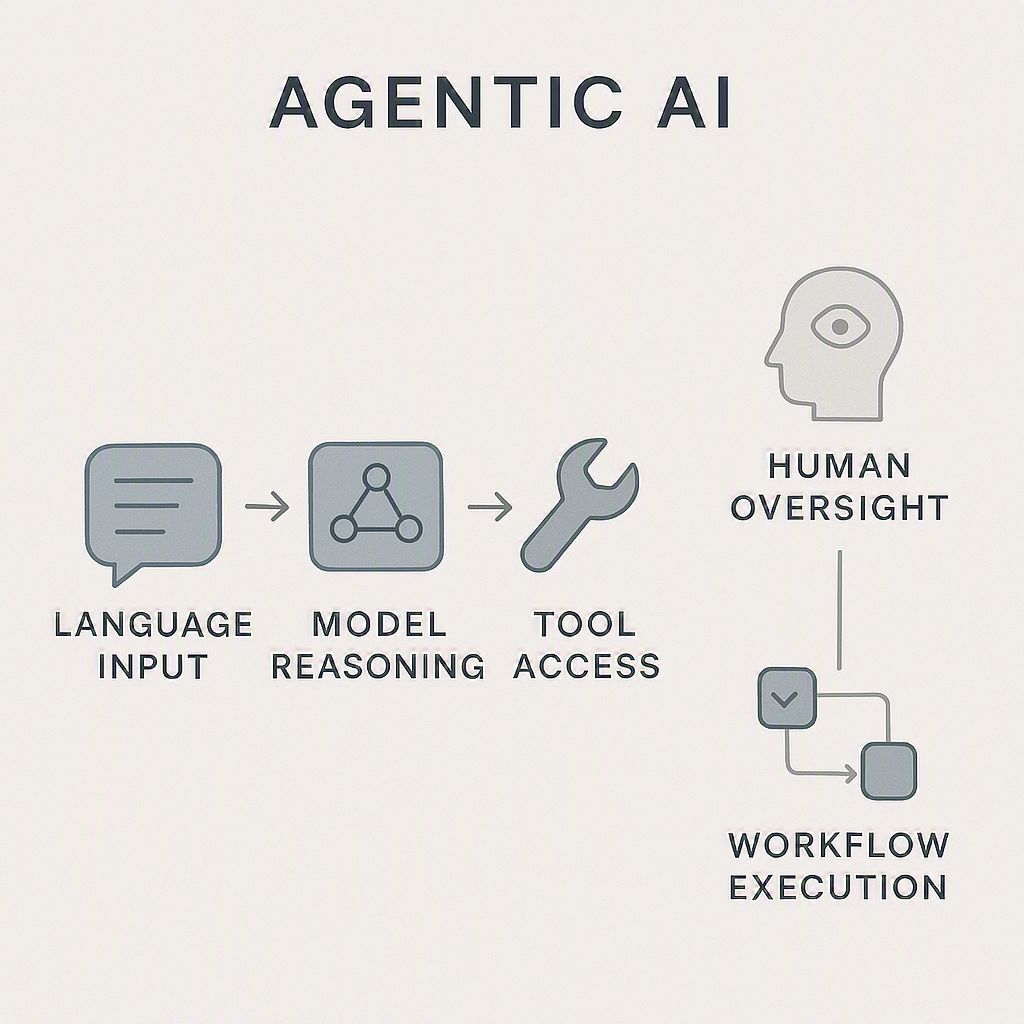
What made OpenClaw so compelling was not that it was a thinking system in any human sense. It was a statistical engine connected to tools. It turned a large language model into an assistant capable of receiving messages, using tools, and maintaining state across multiple channels, with a control interface for configuration and session management. In practice, that meant an AI model sitting behind a relay that could open a browser, read email, call APIs, manage files, or trigger automations on a laptop or server. None of this required understanding in the human sense. It required good prompts, a model, and a carefully wired set of tools. The distinction is important. Large language models generate text token by token. Agentic systems wrap text generation in workflows and provide access to tools. Instead of only predicting the next word in a chat, the model can be asked to decide which tool to use next, how to structure a task into steps, and when to stop. OpenClaw, like similar frameworks, acted as a bridge from language to action: it let the model read a message, choose a ‘skill‘, perform an operation on a local system or external service, and then report back. The resulting behaviour looks like agency. It is still, at heart, pattern matching plus a sequence of triggered procedures. Humans are very susceptible to over-interpreting that sequence. We rely heavily on language and on reading others’ intentions. When something speaks to us in fluent sentences, answers follow-up questions, and adapts its tone, we instinctively infer a mind. When that same system starts to act across our apps, send messages, or modify files on our behalf, the sense of a ‘someone’ behind the interface becomes even stronger. It feels rude not to attribute some form of intelligence to it, even though we know intellectually that it runs on statistics and vector spaces. This tendency may appear as gullibility, but it is actually a side effect of cognitive shortcuts that are useful in human society. Language is one of the strongest signals we have that another entity is capable of thought. Coherent speech usually implies a history of learning, an inner model of the world, and an ability to adjust to context. In human life, that inference works extremely well. When we apply it to machines that generate fluent text by design, it leads us astray. We start to treat linguistic fluency as evidence of conceptual understanding, and successful tool use as evidence of intention. AI is not mystical. It is built on numbers, relationships between numbers, and statistical patterning across high-dimensional spaces. That does not make it trivial, though, but it makes it more understandable. Agent frameworks take advantage of this dynamic almost by construction. The more steps an agent can perform, the more impressive the experience becomes. A simple chatbot that drafts a paragraph feels limited. A system that can read an email, infer the task, look up a document, schedule a meeting, and then send a reply feels qualitatively different. Yet, each added step is just another narrow procedure, not a leap in consciousness. The complexity of the stack grows, and so does the impression of agency. What grows less visibly are the number of failure points and the number of places where human oversight is still essential. The public narrative around OpenClaw was built on that logic. Guides and reviews emphasised that it was not just passing messages to an AI and waiting for a reply, but taking action across apps on its own schedule, sometimes even without a user present. Tutorials promised that with a few steps, you could deploy a ‘24/7 AI employee‘ to manage servers, schedules, and research tasks via a chat interface. That kind of language blurs the line between a tool and a colleague. It encourages people to imagine a general capability that goes far beyond what the system can reliably do in production. Content dynamics added another layer. Tech writing and social posts often reward speed and boldness more than careful qualification. A new feature appears in a library, a framework offers a striking demo, and within days, there are listicles, hot takes, and step-by-step guides describing it as the next standard. Readers who see dozens of posts about agentic AI in a short period reasonably conclude that this approach is mature, widely adopted, and transforming work everywhere. Some pieces are honest about limitations and security risks, but many lean on phrases that treat future potential as though it were already a daily practice. On the technical side, real constraints started to show. Running autonomous agents is expensive, particularly if they rely on high-end models and remain active for long periods. Security concerns are non-trivial. A framework that can read files, send messages, and execute code has access to exactly the resources that an attacker or a misconfigured skill could misuse. As usage increased, incidents and near misses appeared, and people began to realise that letting a semi-autonomous agent roam across personal or business systems without strong guardrails was not a small decision. The platform story also shifted. In early April, Anthropic stopped allowing Claude Pro and Max subscribers to use their flat-rate subscriptions as engines for third-party agent frameworks, starting with OpenClaw. Users who had been running aggressive, always-on agents discovered that they would now need to use separate, pay-as-you-go usage for those workloads, often at a significantly higher cost. Some reported cost increases by factors of ten or more. That move removed a hidden subsidy that had made ambitious agent experiments feel surprisingly cheap. OpenClaw and similar projects could still run on Claude, but under different economic conditions.
The combination of security concerns, cost shifts, and a more sober understanding of the work required to maintain these systems created drag. It did not prove that agentic AI was useless. It did reveal that the easy story of ‘everyone will soon have an AI employee that just runs in the background’ skipped over a lot of friction. A demo that looks magical over a two-minute video is very different from a system that an organisation is willing to rely on every day, with clear accountability when something goes wrong. This brings the discussion to governance and institutions. Policymakers, regulators, and organisational leaders watch the same streams of information as everyone else. They hear the same phrases: ‘autonomous agent’, ‘AI employee’, ‘self-running workflows’. They face pressure to respond quickly to both perceived opportunities and risks. If their picture of the technology is shaped mainly by demos, product marketing, and rapidly produced commentary, they may design rules around a version of AI that is more myth than reality.
That creates two symmetrical risks. One risk is over-reaction to imagined autonomy. Rules might assume that current systems can exercise broad, independent judgment and therefore impose controls that treat them as near-human actors. The other risk is under-reaction to concrete but less glamorous issues, such as identity, access control, auditing, and human-in-the-loop procedures for agents that already touch sensitive systems today. In both cases, the gap between narrative and practice leads to misaligned governance. A more grounded approach begins with technical literacy. Understanding that frameworks like OpenClaw are relay layers that connect language models to tools, rather than minds in a box, changes how we evaluate claims. Recognising that many ‘autonomous’ capabilities depend on brittle prompt chains, specific permissions, and careful monitoring makes it easier to ask the right questions. Who approves the skills? How are credentials stored and scoped? What audit trails exist? Where does human responsibility sit in that loop? For individual users, this literacy lowers the chance of being over-impressed by fluency. When an agent writes a convincing email or completes a sequence of actions, the correct reaction is not fear or blind trust, but curiosity about how that sequence was constructed. For institutions, literacy makes it more natural to separate demonstrations from deployed systems. It encourages them to focus on well-bounded use cases, clear business owners, and measurable outcomes, instead of chasing general notions of ‘AI employees’. The goal is not to be cynical about agentic AI. In many constrained domains, agents that combine deterministic steps with model-based reasoning already provide significant value. They automate routine work, assist in operations, and help humans handle exceptions more efficiently. The problem appears when the story of these tools outruns their real capabilities, and when that story begins to guide decisions about investment and regulation. We are entering a period in which AI systems will speak more fluently, operate across more tools, and feel more present in our workflows. The temptation to equate that presence with genuine understanding will only grow. It is exactly at this point that the distinction between performance and reality becomes critical. Fluency is not understanding. A sequence of actions is not an intention. A compelling demo is not the same as a dependable deployment. If we want to use and govern AI wisely, we need to get comfortable with that distinction. Not to dismiss what these systems can do, but to see more clearly what they are. Author: Slobodan Kovrlija

What OpenClaw actually did
Why humans over-attribute intelligence
How did content inflate the story?
When constraints showed up

Why perception and policy diverge
From awe to literacy