Articles, definite and indefinite, have been hostile towards me for half a century, ever since I started learning English. In this long struggle, editors and, more recently, Grammarly have been my allies. Paradoxically, my difficulty with articles may now have become an advantage: missing articles could prove that my texts are not generated by AI. This ironic reversal points to a broader and more troubling tendency. A few weeks ago, I received a review of my publication that hinted at the use of AI, something I had openly acknowledged in the book’s preface. I had used AI for contrarian dialogue and […]
Articles, definite and indefinite, have been hostile towards me for half a century, ever since I started learning English. In this long struggle, editors and, more recently, Grammarly have been my allies. Paradoxically, my difficulty with articles may now have become an advantage: missing articles could prove that my texts are not generated by AI.
This ironic reversal points to a broader and more troubling tendency. A few weeks ago, I received a review of my publication that hinted at the use of AI, something I had openly acknowledged in the book’s preface. I had used AI for contrarian dialogue and desk research. Yet instead of examining the argument and idea, the review focused mainly on whether AI was used for drafting. In football terms, it played the player, not the ball.
Unfortunately, this seems to be the trend. Recent articles in The Economist and Wired revolve around two questions: was this text written by AI? And how can AI-generated writing be detected? New York Times author pleads dramatically: ‘I am Begging You: Never write with AI’.
This public preoccupation with AI and writing gave me a theme for my summer reflections: revisiting the future of books – or, more precisely, of text – and, even more precisely, of how writing shapes learning and thinking.
My argument is simple: what matters is not whether AI helped write a text, but whether the text is any good and whether the writing process helped the author think clearly and critically.
Before I address this deeper impact of AI on text, here are two main reasons why the current focus on AI writing detection is misguided:
First, AI detectors are inherently unreliable. They cannot credibly distinguish human from machine-generated writing because both draw on the same textual heritage. Humans acquire this heritage through education and reading, while AI models absorb it through machine learning.[1] Rhetorical triplets, balanced sentences, and historical analogies existed long before ChatGPT, yet they are now regularly treated as signs of machine-generated prose.
I ran a test by submitting my 1996 article on ICT and diplomacy to the AI detection platform, which concluded with 99.98% confidence that 53.45% of the text was AI-generated. Although it was written exactly 30 years ago, incidentally in August, the detector identified AI traces, among others, in the use of a rhythmic triplet to describe technology’s impact on diplomacy through ‘geopolitics, topics diplomats negotiate, and tools they use.’ The detector penalised me for the very rhetorical traditions that shaped my thinking. To add to the absurdity, I was offered for a fee to ‘de-AI’ my text using its AI model, selling both the alleged crime and the alibi.
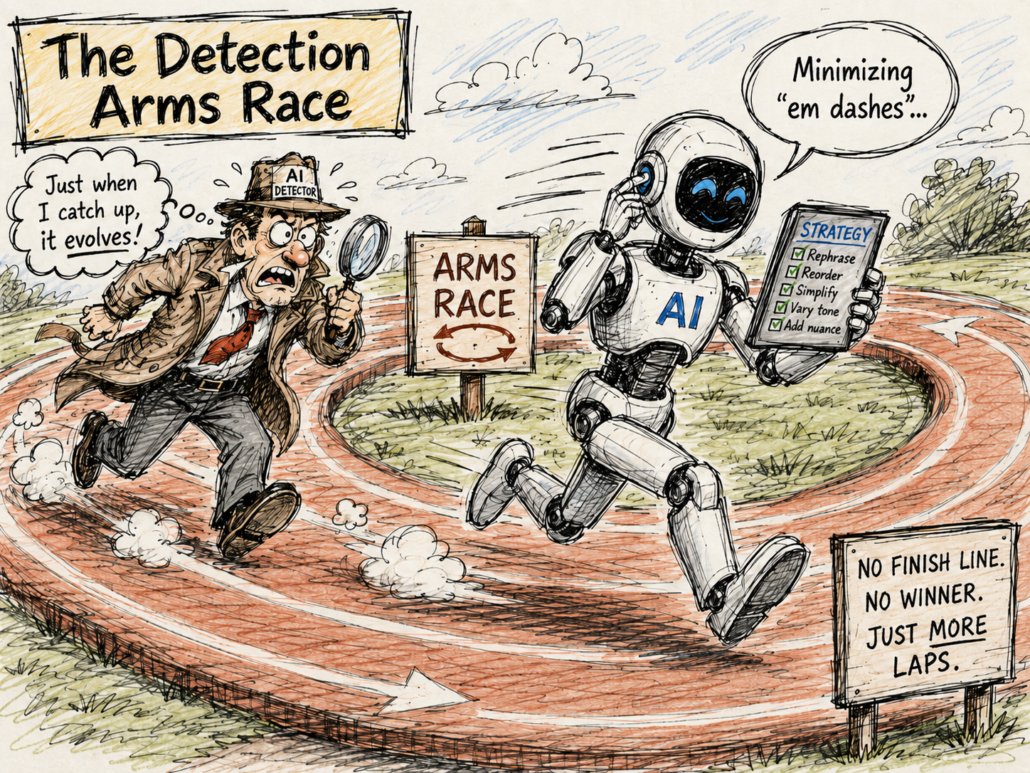
Even if we ignore this in-built flow in detectors, this AI hunting race cannot be won. LLMs continuously camouflage themselves whenever detectors identify some expressions as AI-written. After noting that ’em dashes’ are signals of AI-driven text, ChatGPT minimised their use.
Second, focusing on detecting AI writing misses the forest for the trees(a cliché, which is likely to be identified as AI). AI’s ability to generate sentences is not the problem itself. A much more serious issue is the deterioration of our thinking as we delegate the questioning, interpretation, and judgement to machines. This trend is particularly noticeable in the declining quality of public discussion. For example, in the field of AI governance, which I follow closely, public debate has devolved into a cacophony of trendy binaries: doomers pitted against accelerators, with little critical and practical reflection on what AI risks are and how they should be addressed.
In sum, we tend to obsess over whether text is generated by AI while ignoring the core questions: how can text support thinking, learning, storytelling, and knowledge transmission in the AI era? And how do we preserve critical thinking and meaningful public discourse when it is so tempting to let AI write, and ‘think’, for us?
Here, I try to answer these questions in three steps: first, why text matters so deeply to us; second, what is the role of the text in the current ‘cognitive crisis’ in education and public debates; and third, what are practical ways to preserve human cognition while using AI based on Diplo’s practical and pedagogical experience.
Writing as technology: The ancient anxiety
Writing is so deeply woven into our lives that we often treat it as a given ability, similar to speaking, eating, or breathing.
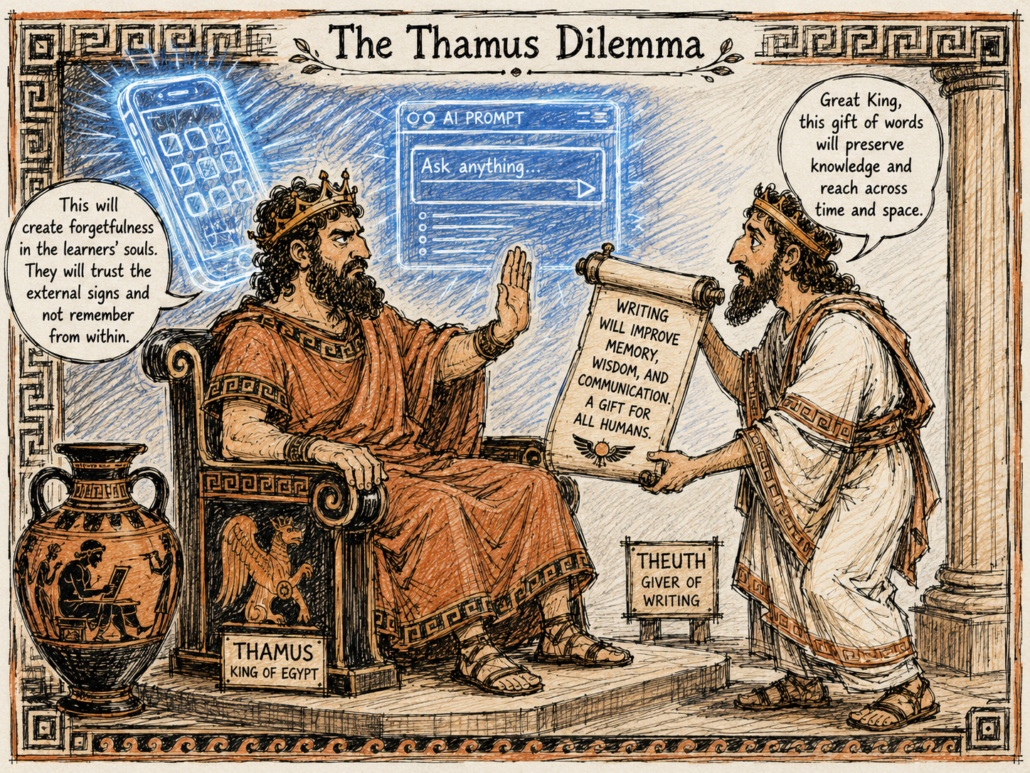
Yet, writing is not natural. It is a technology, as Plato reminds us in Phaedrus, narrating how Theuth, the Egyptian god of invention, presented writing to King Thamus as a breakthrough that would improve memory and wisdom. The king was unconvinced. He warned that dependence on external symbols would weaken our memory and create the appearance of wisdom without genuine understanding.[2]
Two and a half millennia later, writing has proven to be a great invention, profoundly transforming humanity through communication, knowledge preservation, and cognition. It has enabled communication across distances, preserved knowledge across generations, and created new ways of thinking. Sacred texts such as the Bible, the Torah, the Quran, and the Vedas have shaped the worldviews of entire civilisations. Writing has been a medium of scientific progress. Novels, poetry, and philosophy preserved stories and expanded the reach of human imagination and creativity[3].
Yet, King Thamus’s warning remains open: does externalising our thinking make us wiser?
We do not know if we are wiser than ancient people, although there is a saying that all philosophy is just a footnote to Plato. While we leave this question for broader contemplation, it is certain that AI will profoundly shape our cognition. Already, it can generate text, almost magically, without our help.
Such development makes us anxious for a reason. Our critical battle to preserve human cognition – and with it, our core humanity – should begin by focussing more on epistemology than ethics, which has been the fashionable topic in AI discourse. AI deliberations should centre less on the currently dominant question, ‘Is AI aligned with our values,’ and more on practical and immediate questions, ‘How does AI change how we learn and know?’
With this shift towards epistemology, we should advance our answers to several questions: what we gain, what we lose, and which habits of mind we must preserve when we delegate writing to machines.
The education crisis: When machines write student essays
Education is at the centre of epistemological dilemmas on the impact of AI on the way we think. So far, we have seen extensive cognitive offloading from us to machines, for example through the use of ChatGPT for drafting emails, reports, and essays. [4].
But, it did not start with AI. The change of our writing and reading habits has been happening since our communication shifted online. Reading for pleasure in the United States has declined significantly over the past two decades, particularly among younger generations. The longer a text becomes, the less likely it is to be read. Short, interactive fragments have gained in relevance. 46% of Americans younger than 30 get news from TikTok videos.
This is often dismissed as ‘TikTok culture,’ a symptom of fragmented attention and intellectual decline. But such a simplified dismissal should be avoided, since the interactive use of text, images, sound, and dialogue may reactivate deeper layers of human cognition. It is already happening, as younger generations, in particular, prefer YouTube and TikTok to pick up new knowledge and skills compared to traditional classrooms. [5].
This cognitive shift has not been addressed by official education, which is dominated by solitary reading, linear textbooks, extended written assignments, and standardised assessment. Students accumulate credits, teachers deliver prescribed learning activities, and institutions compare performance through performance indicators. Learning becomes more a quantifiable accumulation of credits rather than an exploration driven by curiosity, doubt, creativity, and judgement.
Critical reflection on the educational system should not tarnish a great achievement of industrial education. It extended education from the privileged elite to all citizens, making knowledge transferable on a societal scale.
Yet it is time for major change, as the industrial-era pedagogy, centred around rigid curricula and the quantification of learning, is reaching its limits [6]. It is ill-equipped to address the growing tension between AI technology and human learning [7].
For example, if a machine can generate student essays in minutes, and if those essays themselves, rather than the knowledge process, are what matter for evaluation, students have every right to question the purpose of such exercises. Caught in the gap between the old and the new, teachers often respond by focusing on detection: Was this AI-generated? Which tool was used? Can the student prove authorship?
These questions are symptoms, not structural causes, of the educational crisis. When the final product matters more than the thinking process, AI becomes a rational shortcut. If an assignment exists mainly to satisfy formal requirements, using AI becomes an understandable and efficient choice, even when institutional rules prohibit it.
This tension touches everyone. Teachers see established methods and authority erode. Students doubt the worth of tasks machines can handle. Parents fear schools are preparing children for a world that no longer exists.
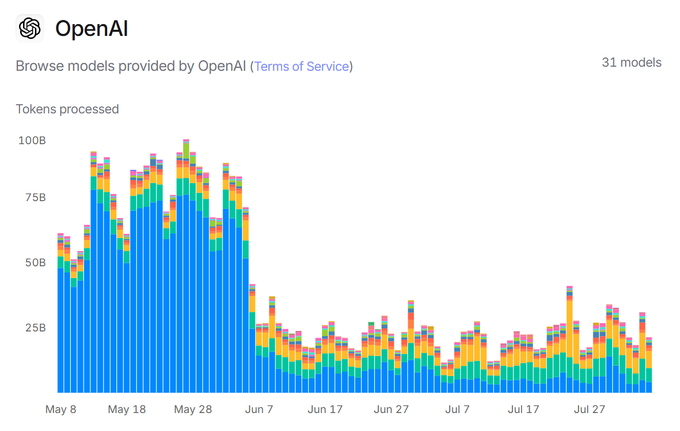
This chart shows a sharp drop in AI use at the end of the 2025 academic year in the Northern Hemisphere.
Banning AI won’t work. The way forward is to redesign pedagogy so that AI can be used to support the development of human cognition: questioning, revision, and judgement.
AI can become an intellectual sparring partner. It can generate counterarguments, identify a missing perspective, or help a student test and restructure an argument. Used well, it can push learners beyond their thinking comfort zone and inertia.
AI assessment should reward the ability to explain decisions, reconsider assumptions, evaluate evidence, defend an argument, and show how thinking changed over the course of the work, not merely the polish of the final submission.
The underlying question is not simply whether students should use AI, but which cognitive capacities education should cultivate and how writing and AI can contribute to them.
Fast AI and Slow Cognition
If speed is the measure, AI wins. It offers instant solutions for an efficiency-driven age. On the other side, cognition takes time to develop. Bridging AI’s rapidity with the slowness of human learning is the real challenge. Inefficient practices can boost cognition. Handwriting stimulates brain activity more than typing. Mental math, memorisation, debate, and even cooking enhance neuroplasticity. It is not realistic nor practical to return to handwriting or memorising. But we can rediscover slowness as a learning tool. Apprenticeships, for instance, take time yet cultivate deep understanding and critical thinking about AI.
Solutions for AI, text, and cognition: Looking backwards to move forwards
There is a major gap between the echoing calls for human-centred AI that should protect human cognition and the lack of practical solutions to achieve it. Most AI projects stop at the first and easiest step: installing the technology. You can install AI agents in a few minutes, but you need weeks and months to develop useful and relevant AI. The so-called AI graveyards of 95% of failed projects are the result of a disconnect between two speeds: the possibility of fast deployment of AI technology and the much slower rhythms of the learning, cognition, and institutional change needed.
When the latest AI wave began with the launch of ChatGPT in November 2022, we at Diplo were acutely aware of the enchantment of easy AI technology and the much more complex cognitive work that truly matters. This awareness was anchored in decades of work on AI, starting with my 1992 master’s thesis on international law and AI (expert systems) and continuing through a focus on knowledge and language for AI in the late 1990s.
Building on this long AI mileage, we have developed the cognitive proximity approach. It works on two levels: first, bringing people closer to one another through coaching, collaboration, dialogue, and shared interpretation; second, ensuring smooth interplay between human and artificial intelligence.
It has been an experiment in developing pedagogy and organisation for the AI era. Yet, these changes have not been easy. Before I outline six practices for cognitive proximity, here are a few challenges that we have encountered, which are as relevant for the discussion of preserving human cognition in the AI era as our successes.
First was the difficult transition from simply using AI to thinking with AI. Initially, we were getting tens of pages of AI-generated answers to simple questions. I started hinting that I could use the same platform and began pushing some thinking around, first through better prompts, and later through the development of customised agents. Some efforts were made, but human cognition was still missing.
The next experiment involved using the native language instead of English to discuss AI. My hypothesis was that our mother tongue is closer to our cognition and, anyhow, AI English terminology started to become another turf, delinked from the cognitive reality of AI platforms. As most of our tech team is based in Serbia, we used Serbian. It worked to some extent until LLMs became equally powerful in Serbian.
The other approach to nudge genuine human cognition was to prepare a short thesis ahead of in vivo discussion, which increased in numbers. The hypothesis was that verbal exchanges are better for human creativity than written exchanges. In addition, human touch is needed when general AI solutions are applied to Diplo’s concrete situation and needs.
One of the main achievements was that we ‘cleaned’ our exchanges from AI hype. The main lesson is that the race to preserve human cognition will be constant, depending more on human habits and inertia than AI technology.
The second challenge for us at Diplo was communication between technical and content professionals. In a situation where both professions are endangered by AI automation, while new solutions are not yet here, they naturally slide into protective mode. This challenge was interesting, as we had a group of highly ethical and competent people with a low level of turf battles and playing typical ‘games’. In addition, the organisational culture is risk-tolerant and not “witch-hunting.”
Yet, it has not been easy to overcome mental barriers between technical and content professional cultures. The key talent is boundary spanning, people who can understand multiple professional cultures on a deeper level of hopes, fears, ways of forming arguments, and so on. We are fortunate to have quite a few boundary spanners at Diplo. For example, content people started vibe-coding technical solutions for their needs, while a few tech people made a step toward the epistemology of developing content taxonomies and ontologies. Boundary spanners will become the key asset of organisations and businesses in the AI transition.
The third challenge has been the institutional and policy environment in which we have to operate. While we have been developing cutting-edge experiments internally with tangible results, our surrounding environment expected outputs from us, shaped by either AI hype or industrial-era quantification.
Reporting and audits focused on quantitative elements and have very little relevance to AI transformation. For example, some AI solutions can emerge from a good exchange in a few minutes, while traditional systems may need weeks and months.
For a small team like Diplo, the outside requirements became a major problem, not only in terms of hours and energy dedicated but, even more importantly, in working on something that often does not make sense in the fast-changing world around us. We found ourselves like students being asked to write essays that have become mere formalities to collect credits. As a matter of fact, we have been working on an AI solution to draft reports in line with long lists of compliance requirements. Until the ‘curriculum’ of our environment evolves, we have to have space to create new solutions for the years ahead of us.
Six practices of cognitive proximity
PRACTICE
CORE CONCEPT
HUMAN CAPABILITY
Apprenticeship
Learning by doing
Skill acquisition through the development of AI applications
Storytelling
Structuring experience into narratives
Meaning-making, ethos, and shared context
Grounding
Anchoring AI outputs to knowledge sources
Attribution, transparency, and intellectual lineage; understanding biases
Shared dialogue, interpretation, and critical engagement
Visualisation
Visualise thinking
Translating abstract concepts into easy-to-grasp visuals
Apprenticeship: Learning by doing
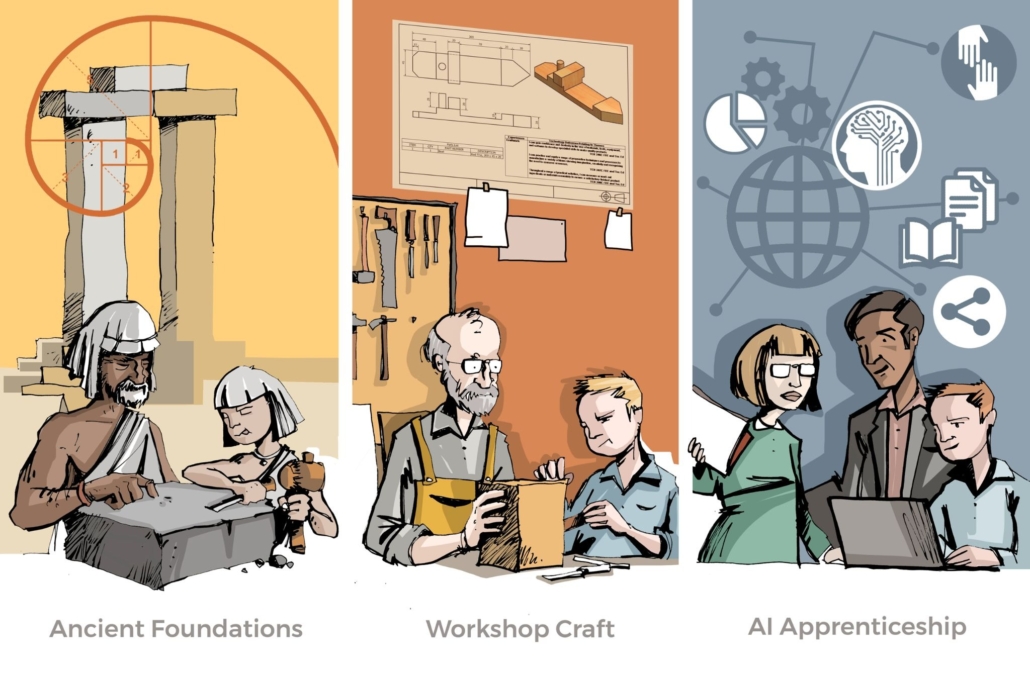
For most of human history, learning by doing has been the main way of acquiring skills and knowledge, from early hunting communities to the builders of pyramids and cathedrals, and into our time. Today, many prefer to learn how to fix a home appliance by watching as somebody else does it on a YouTube video rather than reading manuals.
Evolution of Apprenticeships
This deep anchoring of learning-by-doing in human cognition inspired us to apply this ancient pedagogy to help grasp AI technologies. Over the last two years, more than 300 participants have taken part in our AI apprenticeship programme, learning about AI by building AI applications. Curriculum follows, in parallel, skill development, knowledge acquisition, and wisdom-nudging, all held together by the backbone storyline of developing an AI chatbot.
Apprentices can ‘touch’ concepts such as embeddings, vector databases, model weights, and reinforcement learning. They encounter these concepts while solving problems in the applications they develop and trying to understand how applications work and, particularly relevant, why they sometimes fail to provide good answers.
The learning experience was captured by the comment of one of the apprentices:
‘When I’m following a presentation, I feel like I understand AI. But I only really understand it when I can explain it to someone else. That forces me to engage with the technology much more deeply.’
That comment has stayed with me. It captures how the apprenticeship approach turns AI from an abstract subject into a tangible and practical one.[8]
In this process, apprentices are supported by coaches who help them develop AI assistants and understand the technologies behind them. While engaged in real-world practice, apprentices receive learning ‘scaffolding’ from AI experts and supervisors. As they progress, the scaffolds are progressively withdrawn. Coaches also provide encouragement when learners encounter difficult concepts, confusion, or failure because that is where real learning begins.
This approach is almost the opposite of the prevailing model of massive online learning, in which thousands of participants watch the same lectures and complete automated exercises.
The apprenticeship approach has limitations. Coaching is demanding, and personal support is difficult to scale. It may not satisfy institutional demands for scalable and quantifiable education. That may be the point. Deep learning has always required attention, trust, and human proximity.
Storytelling: Turning experience into meaning
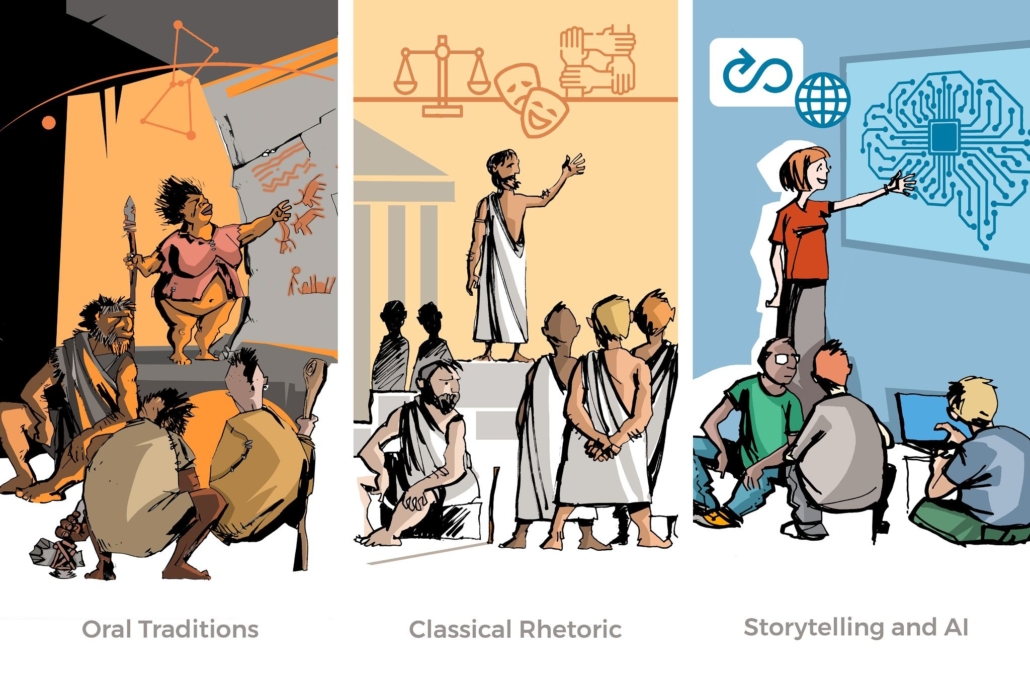
Storytelling is another ancient practice that helps us move beyond what is directly observable towards abstract ideas, dreams, fears, and hopes.
Evolution of storytelling
Storytelling is personal in both its creation and reception. It is shaped by logos (facts and reasoning), ethos (values) and pathos (emotions and intuition). The impact of a story depends on who tells it and who listens.
Our work on the use of AI has been shaped by a dual nature: on one hand, AI’s ease in generating narratives; on the other, the limits of what technology can do with the uniquely human aspects of storytelling. With these limitations in mind, we use AI to help us construct a narrative, organise materials, and improve transitions.
We also use storytelling in our pedagogy as a counterbalance to the multi-modal presentation of snippets: text, video, and other materials. As discussed in the section on visualisation, internet governance is understood by following the story of internet packets, and AI governance by following the journey from asking AI a question to generating an answer.
In our cognitive proximity work, storytelling remains the main challenge in both preserving its human relevance and using it with AI.
Grounding: Tying AI answers to knowledge sources
Stories do not emerge from thin air. They grow from previous arguments, observations, experiences, and interpretations. Ideas have histories.
Academic referencing traces the origins of an argument and identifies the evidence supporting it.
Generative AI often weakens this connection. Typically, AI platforms do not provide links to sources of their inference. While it is technically possible, they avoid grounding to avoid court cases from copyright owners whose texts are often used to train AI models.
Practice of grounding refers to pointing to the source of AI inference, being text, music, or video, while attribution identifies the author of that source. It has a few related concepts of attribution, traceability, interpretability, and explainability. Attribution assigns certain artefacts to an individual or an institution. Traceability follows an AI’s answer back through its chain of reasoning to its original sources. Interpretability is the capacity to understand why a model produced a particular output. Explainability refers to the techniques – visualisations, simplified models – that enable interpretability. All share a common aim: to avoid treating AI as a ‘black box.’
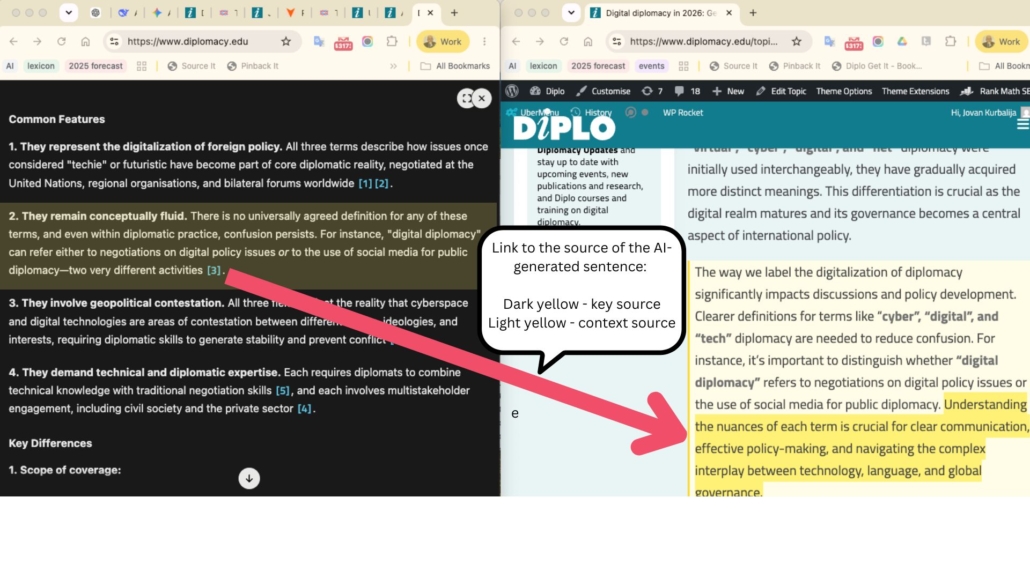
At Diplo, our maxim is to anchor each AI-generated sentence to its textual origin, whether a sentence, paragraph, or section of a book, blog, treaty or any other text. Grounding is much more than just a technical feature. It has an impact on a wide range of AI governance and transformation, as reflected in the titles of AI summits and conferences.
Trust in AI shaken by lack of transparency on how AI functions. While some AI aspects, such as neural networks, escape interpretability, most of AI can be followed, including the grounding of answers. If we know trace AI answers to sources, we will trust AI more.
Bias is another buzzword trending at AI events. Most discussions focus on how large language models can reduce bias in their outputs. Grounding offers a much simpler solution: it points to the origins of bias, tracing it to specific books, articles, and blog posts. Bias thus becomes a matter of individuals and institutions, not some abstract technical feature. Once the origins are identified, biases can be addressed, from illegal ones like the promotion of genocide to those that are ethically and culturally (un)acceptable. Grounding AI bias in its sources can make policy solutions more transparent, constructive, and impactful.
Hallucination is inherent to probabilistic AI. These are guessing machines—immensely powerful, yet fundamentally uncertain. They predict what is most probable, not what is most true. Grounding offers a practical check: when answers are anchored to identifiable sources, the model’s room for invention shrinks. Hallucination does not disappear, but it becomes manageable.
Risks, from existential to existing, are critical for AI. They dominate AI events. Some argue that AI may destroy humanity. Others focus on existing risks for jobs and education. Debates are often ideological, shaped by the ‘my view vs the wrong one’ approach. Grounding AI can reduce this confusion by providing greater clarity. Risks can be addressed in informed and transparent ways.
Anxiety emerges from the perceived or real AI risks. Anxiety triggers fear, technophobia, and sometimes neo-Luddism. According to the latest Forbes study, ‘seven in ten Americans oppose constructing data centres for AI in their local areas.’ AI anxiety prevents informed and inclusive discussion on AI, from issues to data centres to jobs and education. As knowledge is the best antidote in such situations, grounding and attribution of AI can increase understanding and make the public less susceptible to fearmongering and manipulation.
On the organisational level, grounding and attribution become critical for AI transformation. When employees see their knowledge valued and attributed in AI answers, they can overcome the labour paradox of training AI to replace them.
How can AI grounding refocus summit and event agendas from fear to human potential?
AI has become a dominant theme at thousands of summits, conferences, and workshops worldwide. Since the start of this year alone, we have counted over 150 such events in Geneva, a staggering investment of person-days, with some gatherings drawing thousands of attendees.
Our analysis of these Geneva-based events reveals that nearly half of all sessions and discussions are consumed by topics like trust, accuracy, bias, risks, hallucinations, and anxiety. While these are valid concerns, many of them can be effectively addressed through AI grounding, techniques that anchor AI outputs in verifiable data. This suggests that the current event agenda is disproportionately focused on manageable technical challenges, leaving little room for more consequential questions.
What about a strategic refocus by event organisers and hosts toward how AI can preserve, activate, and amplify the human knowledge embedded in citizens, communities, and nations? Such a shift would embody the much-touted principle of human-centred AI in practice, not just in name. More importantly, it would transform the prevailing atmosphere from one of defensive anxiety to informed, confident engagement, where societies embrace AI with a clear-eyed understanding of both its risks and its transformative potential.
DiploAI grounding in practice
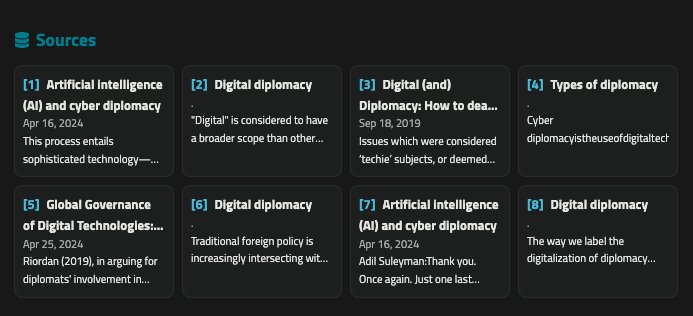
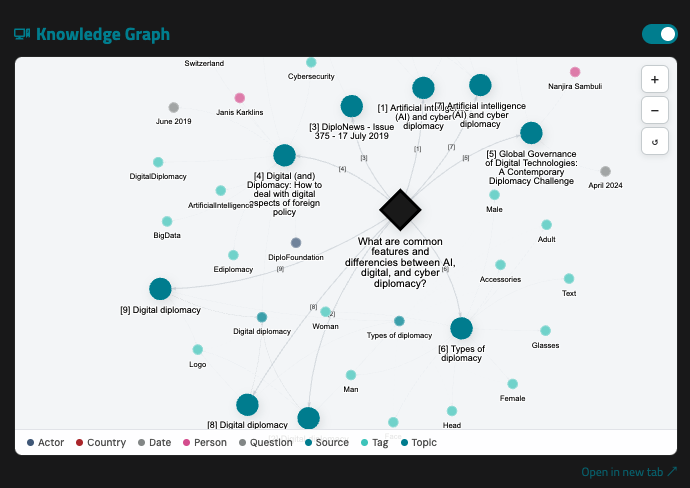
As the grounding of AI answers may look abstract, here is an example of DiploAI answering the question: ‘What are the common features and differences between AI, digital, and cyber diplomacy?’ It includes AI inference (answer) with grounding references, followed by an explanation of 4 layers of AI grounding: sentence/paragraph, document, and knowledge graph.
AI inference (answer) with grounding references
What are the common features and differences between AI, digital, and cyber diplomacy? See answer by DiploAI:
Answer
Based on the available material, here is an overview of the common features and key differences between AI, digital, and cyber diplomacy:
Common Features
1. They represent the digitalisation of foreign policy. All three terms describe how issues once considered “techie” or futuristic have become part of core diplomatic reality, negotiated at the United Nations, regional organisations, and bilateral forums worldwide [1][2].
2. They remain conceptually fluid. There is no universally agreed definition for any of these terms, and even within diplomatic practice, confusion persists. For instance, “digital diplomacy” can refer either to negotiations on digital policy issues or to the use of social media for public diplomacy—two very different activities [3].
3. They involve geopolitical contestation. All three fields reflect the reality that cyberspace and digital technologies are areas of contestation between different values, ideologies, and interests, requiring diplomatic skills to generate stability and prevent conflict [4].
4. They demand technical and diplomatic expertise. Each requires diplomats to combine technical knowledge with traditional negotiation skills [5], and each involves multistakeholder engagement, including with civil society and the private sector [4].
Key Differences
1. Scope of coverage:
Digital diplomacy is the broadest term. It encompasses not just specific applications or security issues, but the entire socio-economic transformation driven by technology—including infrastructure, economy, governance, rights, and diplomacy itself [6]. Since 2011, it has been the most frequently used term in academic literature, reflecting its capacity to capture fundamental and pervasive change [6].
Cyber diplomacy is narrower and security-focused. It deals specifically with issues of cybersecurity, data privacy, digital infrastructure, and international behavioural norms in cyberspace [7][5]. It is the application of diplomacy to cyberspace as a contested domain [4].
AI diplomacy is the most specific, focusing on artificial intelligence governance—hardware, data, algorithms, and applications [8]. It addresses distinct questions such as data sovereignty, intellectual property over training data, risk management (from short-term disinformation to long-term existential risks), and the monopolisation of knowledge by a few tech companies [9].
2. Orientation:
Digital diplomacy can mean both the use of digital tools to conduct diplomacy (e.g., social media outreach) and the negotiation of digital policy issues [3].
Cyber diplomacy is primarily about negotiating norms and agreements for cyberspace. As Riordan (2019) puts it: “If digital diplomacy is the application of digital technologies to diplomacy, then cyber diplomacy is the application of diplomacy to cyberspace” [4].
AI diplomacy focuses on governing AI systems themselves—who owns the data, how algorithms are developed, and how to protect national and regional knowledge assets from exploitation by major corporations [8][9].
3. Connotation and framing:
Digital carries a relatively neutral connotation, making it suitable for framing ambitious, forward-looking policies [6].
Cyber has a security-focused, often defensive connotation, linked to threats, attacks, and state behaviour in cyberspace [6][4].
AI carries connotations of both opportunity and risk—from the hype of technological transformation to fears of monopolies and existential threats [9].
4. Key governance issues:
Domain
Core concerns
Digital diplomacy
Whole-of-society transformation, digital economy, rights, infrastructure [6][1]
Cyber diplomacy
Norms of responsible state behaviour, cybersecurity, conflict prevention, data privacy [4][5]
AI diplomacy
Algorithmic governance, data ownership and sovereignty, intellectual property, risk management at multiple levels [8][9]
In summary, while all three are interconnected and often overlap in practice, digital diplomacy is the umbrella term for the broadest transformation, cyber diplomacy zooms in on security and norms in cyberspace, and AI diplomacy addresses the specific governance challenges raised by artificial intelligence technologies.
If you would like to explore any of these areas in greater depth, I would be happy to suggest relevant documents, courses, or expert analyses from our platform.
Sentence/paragraph grounding
Document grounding
Knowledge graph grounding
Technically speaking, grounding is implemented at Diplo through a nested chunking approach. The search for relevant sources begins with a sentence from the Diplo textual corpus and then expands to the paragraph and the wider context. The reader can move from an AI-generated answer to the evidence and narrative surrounding it. This is part of keeping a system understandable, observable, and predictable, regardless of LLM, which is used for generating answers.
KaiZen publishing: Books that never finish
KaiZen publishing emerged from the tension between the book’s finality as an artefact and the dynamic production of knowledge and data. The name is inspired by kaizen, a Japanese term associated with steady and continuous improvement. Applied to publishing, it means treating a book not as a permanently finished object but as a living narrative. Diplo’s publications embody this concept by constantly evolving through a blend of human expertise and AI updating. KaiZen approach is also used for updating course materials.
How does it work? An AI agent identifies new resources and articles related to a specific concept, chapter, or even paragraph in the original book. For example, for my book on the History of Diplomacy and Technology, I recently received an update on a highly specific subject, Byzantine protocol, from a roundtable discussion at a small university, which I would not have been able to identify otherwise. This is a ‘collateral’ advantage of KaiZen publishing: bypassing the gatekeepers that dominate established academic journals and communication channels.
I review this rich collection of updates regularly. At least once a year, I filter the most relevant ones and prepare a new printed edition of my book. The History of Diplomacy and Technology is now in its third edition.
I find this combination of old and new approaches optimal. The printed book provides coherence and closure. It offers a linear narrative that the reader can enter and follow. AI keeps the research surrounding the book dynamic. It helps identify what has changed and where the text may need reconsideration.
The book remains a book, but it no longer has to remain a passive artefact confined to a library shelf.
KaiZen publishing does not mean endless automatic updating. It means combining the stability of authorship with the possibility of returning to a text and improving it over time.
Annotation: Text as meeting space
For centuries, scholars and theologians have annotated sacred and foundational texts, including the Talmud, the Bible, the Qur’an, and the Vedas. Layers of commentary developed around these texts, sometimes clarifying them, often generating new interpretations and disagreements. In The Talmud and the Internet Jonathan Rosen described vividly that a page of the Talmud bears…
… a certain uncanny resemblance to a home page on the Internet, on which nothing is whole in itself but where icons and text boxes are doorways through which visitors pass into an infinity of cross-referenced texts and conversations.
Medieval codices carried the tradition of annotation forward. The central part of the page held the primary text, while subsequent readers added explanations and commentary in the margins. The codex became, over time, a network of text and interpretation.
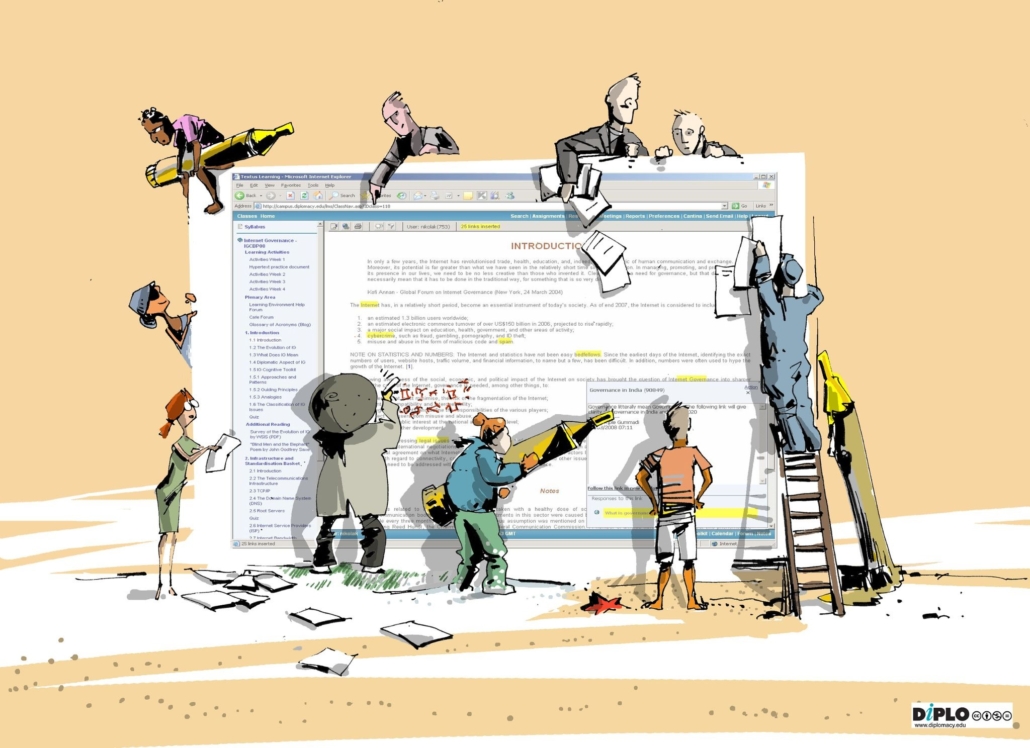
This tradition inspired our Textus hypertext annotation system, which Diplo has used in research and teaching for two decades. Our students have produced millions of annotations on texts concerning diplomacy, negotiation, international relations, and other fields. In one week alone, students make several hundred annotations—the digital equivalent of questions and comments in a traditional classroom. This offers a glimpse of the intellectual vibrancy that emerges when readers engage directly with texts, tutors, and one another across many time zones.
Through annotation, the text ceases to be a passive object. It becomes a meeting space. The original narrative remains, but other voices gather around it.
Annotation reveals a paradox of digital knowledge. It is intuitive and well-suited to multimodal learning, yet it remains marginal in formal education. One reason is that current pedagogy is centred on the linear sequencing of texts and knowledge. The gap will likely narrow with a new generation cognitively shaped by multimedia and multi-sequential thinking.
Visualisation: Thinking with images
Long before writing, our distant predecessors drew on cave walls. In the La Roche-Cotard cave in France, markings associated with Neanderthals are around 50,000 years old; the better-preserved paintings of the Lascaux cave date to 17,000 years ago.
Current fascination with visual communication may therefore be less novel than it appears. Infographics, drawings, short videos, and interactive formats respond to a longstanding human inclination to grasp ideas visually.
At Diplo, our resident artists have created hundreds of illustrations to explain abstract questions in diplomacy and technology since the 1990s. AI tools now allow lecturers to customise drawings, infographics, and videos more easily for particular learning situations.
For example, visualisation combined with storytelling is used in our internet governance and AI training. The journey of internet packets, including those carrying the very words that you read now, is followed. Infrastructure, protocols, platforms, jurisdictions, and policy choices appear at different points along the way. The packet connects technical processes to economic, legal, political, and social questions. It also shows how packet-switched networks can route messages through alternative paths when one route is unavailable.
We use a similar approach to explain what happens when someone asks ChatGPT a question. The journey begins with the user interface, passes through internet infrastructure, reaches AI systems and vector databases, retrieves relevant material, and ends with the generation of an answer.
At each stage, technical details connect to governance and philosophical questions. Where does the information come from? Who controls the infrastructure? Which knowledge is retrieved? Why is one answer generated rather than another? Who is responsible when the answer is wrong?
Visualising AI processes can shift debates on AI risks away from science-fiction speculation and towards a clearer understanding of how the technology actually works.
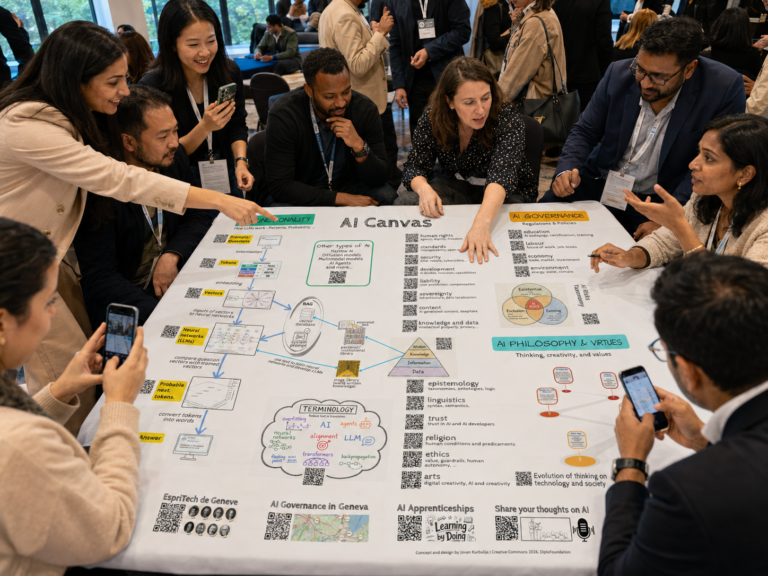
Sometimes, visualisation gets new, unexpected uses. For example, the AI Canvas became a tablecloth at Geneva AI Week in July. From passive presentation, drawing triggered a shared space for conversation on AI.
Table discussion on AI governance
To sum up: Articles, King Thamus, and the future of text
My struggle with English articles may have been an asset all along, revealing the absurdity of our current obsession with detecting AI writing. Just as a detector misread my 30-year-old article as partly machine-generated, we risk misreading the central challenge of our time. The real question is not who – or what – generated a sentence, but what happened to human thinking in the process.
King Thamus warned that writing could create the appearance of wisdom without genuine understanding. Two and a half millennia later, writing did not destroy human cognition; it transformed it. AI confronts us with a similar challenge, but at much greater speed.
The task is therefore not to defend old forms of writing simply because they are familiar, nor to embrace AI-generated text simply because it is efficient. It is to determine which human capabilities we want to preserve and cultivate as machines become increasingly capable of producing the textual artefacts that once served as evidence of learning and thinking.
This requires more than better AI detectors. It requires a new pedagogy and, more broadly, a new culture of cognitive cultivation. We need to create space for the slow processes through which people learn to question, interpret, connect, doubt, imagine, and judge.
At Diplo, we are experimenting with this through cognitive proximity: apprenticeship, storytelling, grounding, KaiZen publishing, annotation, and visualisation. These practices are very different, but they share one principle: AI should bring us closer to knowledge, to other people, and to our own thinking rather than distance us from them.
Text itself will change in this process. It may become more dynamic through continuous updating, more transparent through grounding, more conversational through annotation, and more closely intertwined with images, dialogue, and other forms of communication. The book may no longer be the final destination of knowledge, but it can remain an important anchor: a coherent narrative around which these other forms develop.
The medium will change. The mission will not: to use text, and now AI, to help us think.
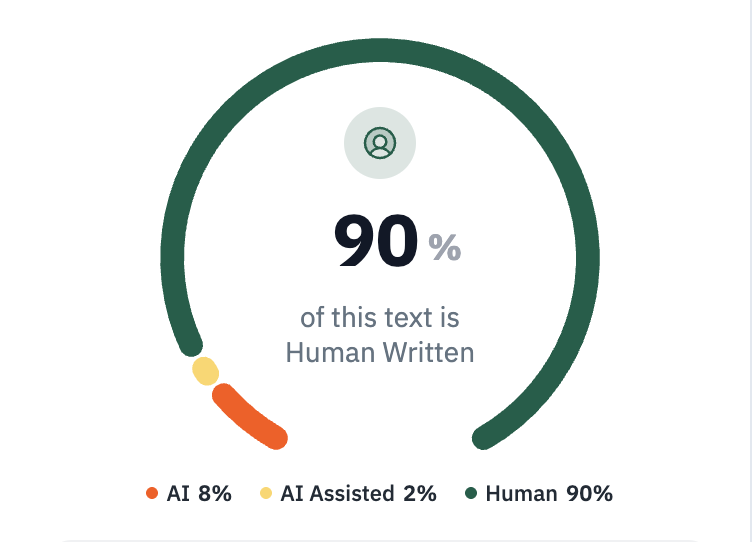
According to Pangram’s AI detection analysis, this text is 90% written by me. Paradoxically, ‘my’ percentage is too high as I used DiploAI and occasionally AI-trinity (ChatGPT, Deepseek, and Claude) to probe my thoughts and ideas. A more realistic estimate would be 70% human, 25% AI-assisted, and 5% AI.
It appears that I was successful in camouflaging AI with intentional spelling mistakes, missing articles, and a preference for tetracolons (4-part structures) over triplets.