“We are already too late to govern AI.” This has become one of the most common refrains in media discussions about AI. But is it really true? Not necessarily. More than 2,500 years ago Aesop offered a different lesson in The Tortoise and the Hare, that of slow and steady winning the race. That ancient wisdom echoed throughout this week’s UN AI Dialogue and AI for Good Summit at Geneva’s Palexpo conference centre. Perhaps the UN’s greatest strength in AI governance is precisely that it moves more like Aesop’s tortoise than the hare. It can sound counterintuitive to praise slowness in the era of efficiency, speed, and optimisation. Yet, when it comes to the governing impact of (un)known technology on human society, the UN’s deliberate pace may turn out to be an unexpected advantage, as discussed further in this text. AI governance debates are often dominated by striking slogans and dramatic analogies. AI is compared with nuclear weapons, climate change, or pandemics. While such comparisons attract attention, they rarely help policymakers decide what should actually be regulated. The Global AI Dialogue was refreshingly different. Rather than repeating abstract warnings, the Global AI Dialogue focused on more concrete concerns such as employment, education, misinformation, cybersecurity, and public services. This shift towards specifics makes AI governance far more practical and useful. Once we examine the specifics of AI, we can realise that many rules for governing AI already exist. Data protection laws, consumer protection, intellectual property rules, labour legislation, human rights frameworks, and humanitarian law already provide much of the legal architecture needed to address today’s AI risks. In some areas, such as autonomous weapons, existing legal frameworks may require clarification or adaptation rather than wholesale replacement. The real challenge is therefore often less about inventing new rules than about applying, updating, and enforcing the ones we already have. One of the most encouraging aspects of the week was the diversity of voices. Heads of state, ministers, scientists, engineers, entrepreneurs, educators, youth representatives, and civil society from all continents contributed to the discussion. At times, it felt like a collective therapy session for humanity as participants expressed hopes, anxieties, and uncertainties about living alongside increasingly capable AI systems. Some concerns echoed familiar media narratives. Others reflected very tangible experiences, particularly regarding education, employment, creativity, and human agency. This broad participation matters, as AI governance cannot be designed only by governments or technology companies. Another welcome development was the relative absence of AI gurus promising that another trillion parameters or the next model release would transform civilisation overnight. Instead, the spotlight increasingly shifted towards practitioners. Teachers, diplomats, healthcare professionals, engineers, researchers, entrepreneurs, and public servants shared practical experiences of integrating AI into their daily work. They were less interested in predicting the future than in understanding how to make today’s systems genuinely useful and safe. This reflects a broader transition. AI is becoming a commodity rather than a media spectacle. The future of AI governance debates may therefore depend less on celebrity experts and more on thousands of experienced practitioners acting as ‘guides on the side.’ Perhaps the UN’s critical contribution lies in its ability to weave together many strands of AI governance. Political dialogue, scientific advice, technical expertise, capacity development, and multistakeholder participation are often treated as separate activities elsewhere in business and academic debates. The UN has experience and expertise to nurture holistic governance approaches that require patience, listening, and continuous stitching together of different perspectives. That patient knitting may ultimately produce a stronger and more durable framework than attempts to sprint towards quick AI governance fixes. AI Canvas by jovank For all its strengths, the UN’s newly presented scientific report remains the main weak spot in this emerging governance framework. Understandably, it was produced under significant time pressure. The challenge is not only to have enough time to gather more evidence but also, and more importantly, to develop a suitable method to do this. First, in the issue coverage, the report tends to read more like a policy document than a scientific assessment. There is relatively little explanation of the underlying technologies or even less scientific findings on how specific technologies – neural networks, weights, model architecture – can impact society. For example, on open-source AI, one of the critical issues of AI developments, the report does not go deeper into the way what and how openness of weights, data, and model infrastructure could be (mis)used. Second, the method used makes the report read more like the result of diplomatic negotiations than of scientific inquiry. As Maria Ressa, the Panel’s co-chair, put it in Geneva, the report is ‘the minimum we all agree on. the floor of our concern, not the ceiling.’ This way of handling things works well in diplomacy, but not in science. Science needs to show the evidence clearly. It should also share different ideas, uncertainties, and disagreements when they are there. So, a balanced approach to AI means not hiding these differences. Instead, it should show the different scientific views and the uncertainties that come with AI systems that work with probabilities. The Panel can share findings that are fully agreed on, those where most (about two-thirds) agree, and those where there is no agreement at all. Negotiators need a full set of facts, including diverse viewpoints, to reach compromises and develop diplomatic solutions that consider various political, social, and economic interests. This is the heart of diplomacy. Scientists and technologists play different roles: they explain complex topics clearly and point out where they cannot reach consensus. Overall, this week’s dialogues and the UN report mark an important step towards global AI governance. As our understanding of AI’s challenges becomes more precise, better governance solutions will emerge. Meanwhile, Aesop’s lesson remains surprisingly relevant. The UN may never be the fastest actor in the AI race. But by remaining deliberate, inclusive, and patient, it may ultimately produce something more valuable than speed: legitimacy, trust, and governance that works. In the race to govern AI, slow and steady may yet turn out to be the wisest path.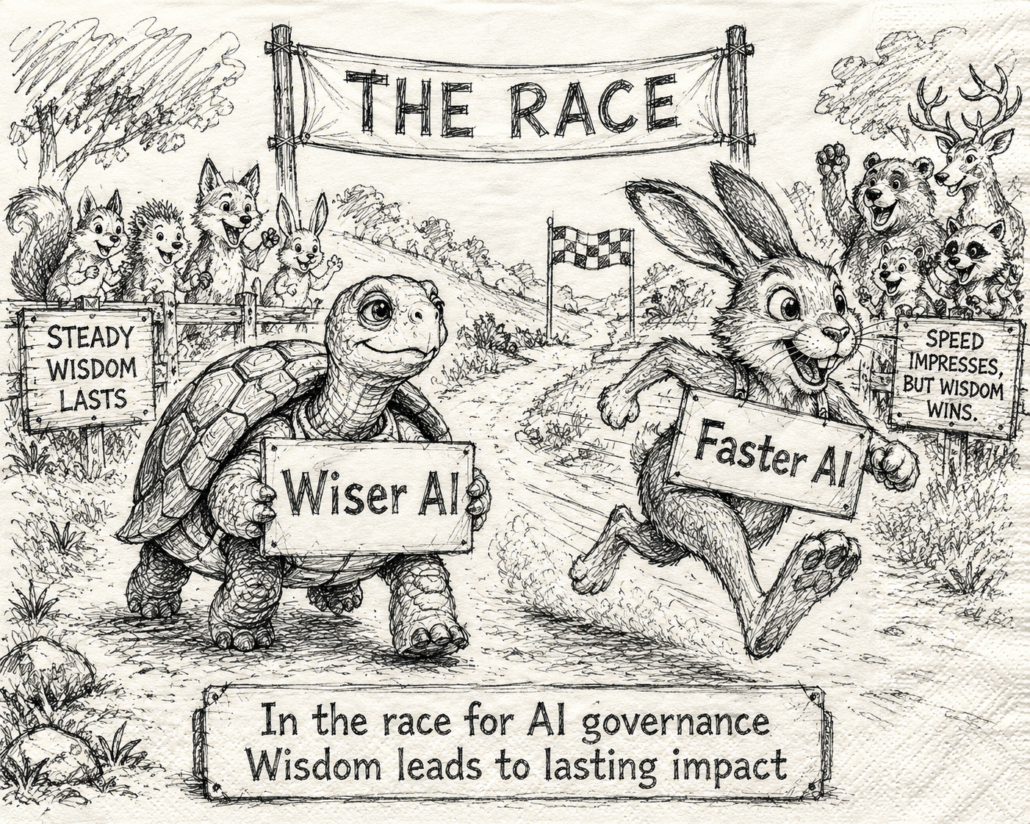
1. Moving from slogans to specifics
2. Louder voices, broader perspectives
3. Fewer sages on the stage, more guides on the side
4. Knitting the AI governance tapestry
Where the tapestry still has holes
Slow can still win