Today’s dominant AI systems are built around language. Large language models can summarise documents, generate code, draft policies, and even sustain remarkably plausible conversations. Multimodal extensions add images, audio, and video. But most of these systems still operate primarily by recognising and generating patterns in data, rather than by maintaining a coherent model of a changing world. This is why a growing group of AI researchers argues that real intelligence may depend less on endlessly scaling text prediction and more on building world models: AI systems that learn to simulate and predict how environments change over time.
A world model builds an internal representation of an environment and learns how that environment evolves in response to actions. It is designed to answer questions such as: What happens if I brake now? What changes if I reroute emergency crews through this district? Or what is likely to occur if a production parameter is adjusted? LLMs and world models both learn statistical regularities from data. The difference is what they represent and predict. LLMs generally estimate the next token from preceding context. World models estimate how an environment is likely to evolve from its current state, often conditional on a possible action. Their predictions may take the form of future sensor values, structured states, images, or compact latent representations (abstract mathematical summaries of an environment) rather than language tokens. The boundary is not absolute. Multimodal language models can acquire implicit knowledge of physics, causality, and action consequences, while world models may use language as an input or output and may sometimes represent environments through discrete tokens. The terms therefore describe an architectural and training emphasis, rather than two wholly separate kinds of AI. Put differently, LLMs can often describe how the world works, while world models aim to give an AI system an internal simulator for anticipating what may happen next. The concept is far from new. Jürgen Schmidhuber introduced the term “world model” in machine learning in 1990, proposing recurrent neural networks that predict future states and use those predictions to train agents. David Ha and Schmidhuber revived the idea in 2018 in their influential “World Models” paper, where agents learned to drive virtual cars and play games inside self‑generated simulations. Yann LeCun pushed the concept further in a 2022 position paper on autonomous machine intelligence, arguing that real intelligence requires predictive models of the world, and proposing JEPA (Joint‑Embedding Predictive Architecture) as a practical approach. What is new is the surging visibility and investment behind world models in the mid‑2020s. Major labs and startups are now placing them at the centre of their research: ➣ LeCun’s Advanced Machine Intelligence Labs (AMI Labs) raised a USD 1 billion seed round in early 2026 at a multi‑billion valuation. ➣ Fei‑Fei Li’s World Labs and video‑focused companies like Runway and Luma have attracted similar funding. ➣ Google DeepMind’s Genie, NVIDIA’s Cosmos, and other platforms are explicitly framed as world‑model or ‘world foundation model‘ systems. As these architectures scale toward frontier-class AI systems capable of autonomous planning, they are prompting calls for dedicated safety standards and multilateral oversight bodies. There is a lively (and very on‑brand) credit dispute between Schmidhuber and LeCun, but both acknowledge that the core idea is older, going back to optimal control theory from the 1950s–60s. The current moment is less about invention and more about industrialisation, i.e. turning a decades‑old research idea into infrastructure for autonomy.
World models are gaining attention because they move AI from description to intervention. LLMs excel at describing, summarising, and generating content. World models are being designed for planning and counterfactual reasoning: ‘What would happen if we did X instead of Y?’ This move has three practical consequences. 1) Learning with fewer real‑world trials In robotics, autonomous driving, and industrial control, learning purely by trial and error in the real world is slow, expensive, and risky. World models let systems train inside learned simulations, trying millions of variations before touching real hardware. This is already the primary commercial use of world models: generating synthetic data to train self‑driving systems and robots, including rare but critical scenarios like accidents or equipment failures that are under‑represented in real datasets. 2) Generalisation across variation Real environments are messy: different products, layouts, lighting conditions, traffic patterns, failure modes, etc. World models help systems generalise across this variation, rather than needing a separate hand‑tuned model for every configuration. The same capability matters in industry, where processes must adapt to product variants and shifting conditions, but the core point is broader: world models are a general tool for spatial and temporal reasoning in complex, changing environments. 3) Enabling spatial intelligence Fei‑Fei Li and others describe world models as a pathway to spatial intelligence: the ability to understand a physical environment and use that understanding to guide action. This goes beyond recognising objects in images; it means tracking a coherent environment over time, reasoning about geometry, physics, and interaction, and using that to plan. In crisis response, a world model could integrate real-time updates on transport networks and hospital capacity into a single simulation, allowing commanders to test evacuation plans before issuing orders. In engineering and public planning, those same capabilities allow teams to stress-test designs in silico long before committing resources in the physical world. We do not experience the world as a sequence of disconnected snapshots. We carry forward a working sense of where we are, what has changed, and what might happen next, and we can rehearse actions internally before committing to them. In its modest computational form, this is the intuition behind a world model. The comparison points somewhere specific, though: humans did not develop their cognitive capacity mainly to describe possible futures to one another. We developed it to decide what to do ourselves. A world model serves the same purpose: to give an artificial system the internal foundation to choose an action, rather than just produce a forecast. That predictive capacity gets used in two ways. Most directly, it is built into the acting system itself. A self-driving car, an industrial robot, a warehouse system: these need to estimate what happens next in order to choose an action, often in a fraction of a second, with no person available to weigh in. This is already, as noted above, the main commercial use of world models: training such agents inside simulated environments before they touch reality. The same predictive core can also support people directly, without an agent acting in between. Faced with a question like ‘what happens if this bridge closes for a week?’, or ‘which evacuation route still works if a road is unavailable?’, a world model can lay out several plausible futures instead of just one. It expands the range of scenarios a decision-maker can hold in their mind at once. It does not settle the decision itself. That’s a genuine and valuable use, even if it’s not the reason the underlying architecture was built. In any case, the model does not decide what matters. It can estimate probable outcomes, not what is fair or worth sacrificing. It can show trade-offs, but it can’t choose whose priorities should prevail. That holds whether a person assesses each decision as it comes or stands one step back, having set the goals the agent then pursues on its own. Either way, responsibility stays with the person.
Strip away the specifics, and a world model answers one question: given how things stand now, what happens next if this action is taken? A large language model can describe that question in words. A world model tries to work out the answer itself, whether the thing in question is a stretch of road, a factory line, or a city under strain. When you give that capacity to a person, it becomes a way to test alternatives before committing to a decision. An evacuation route, a design choice, a policy trade-off: it can lay out where each one leads, without making the choice itself. Built into a machine, it becomes something closer to judgement. The agent weighs a handful of possible next moves against its own model of the world, and picks one, often in the time it takes to brake or reroute. The second use is where much of the current investment and ambition are concentrated. Robots, vehicles, and industrial systems are moving from executing fixed instructions to planning against an internal sense of how their surroundings behave. That is the emerging domain of physical AI. It also raises questions. Who answers for a machine’s internal model when it turns out to be wrong? How much freedom to act is safe to hand to a system that is, underneath it all, still working from a prediction? These concerns deserve their own piece. Author: Slobodan Kovrlija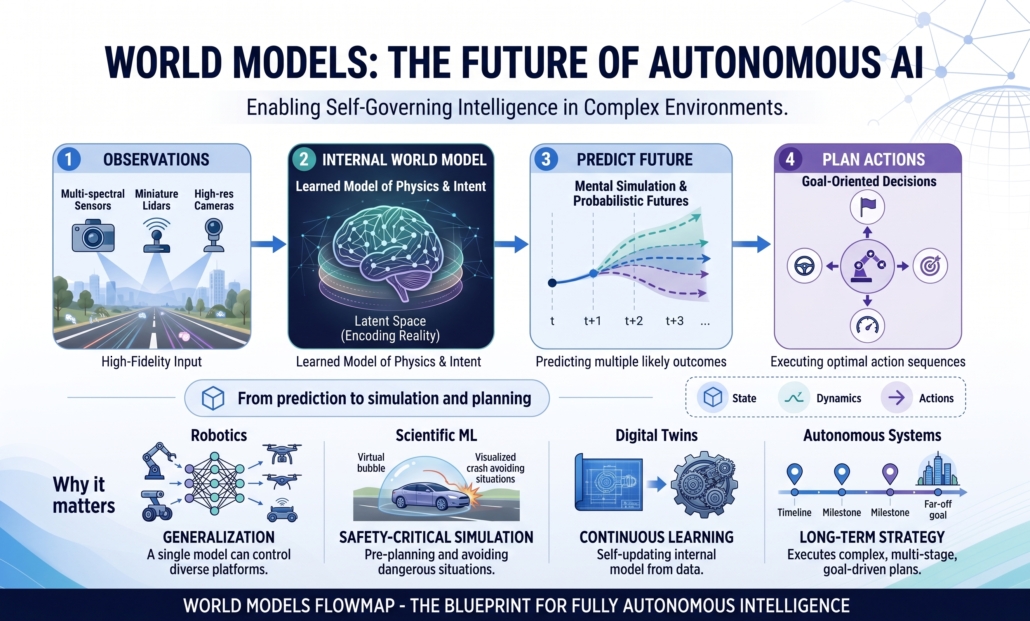
Old idea, new momentum

Why the renewed interest in world models
The human capacity behind the idea

From world models to physical AI